As part of Lit Society’s Book Review Program, members are reading and reviewing books by independent writers we think deserve more attention. This review reflects one reader’s honest experience and aims to spotlight exciting new voices.
Big Take? An emotional exploration of class, marriage, and familial duty during the turn of the twentieth century. Readers who love the complexities of high society, relationships, and upward mobility during the Gilded Age will be enthralled.
- Would You Recommend It? Yes
- Book Club Worthy? Yes
- Would You Read This Author Again? Yes
- Did It Change How You See Something? Yes
- Is It More Plot or Ideas? Ideas
- Pace: Steady
- Emotional Impact: Lingering
- Best For: Quiet Weekend
- Skimmable or Demands Attention? Close Reading
- Would You Reread It? Yes
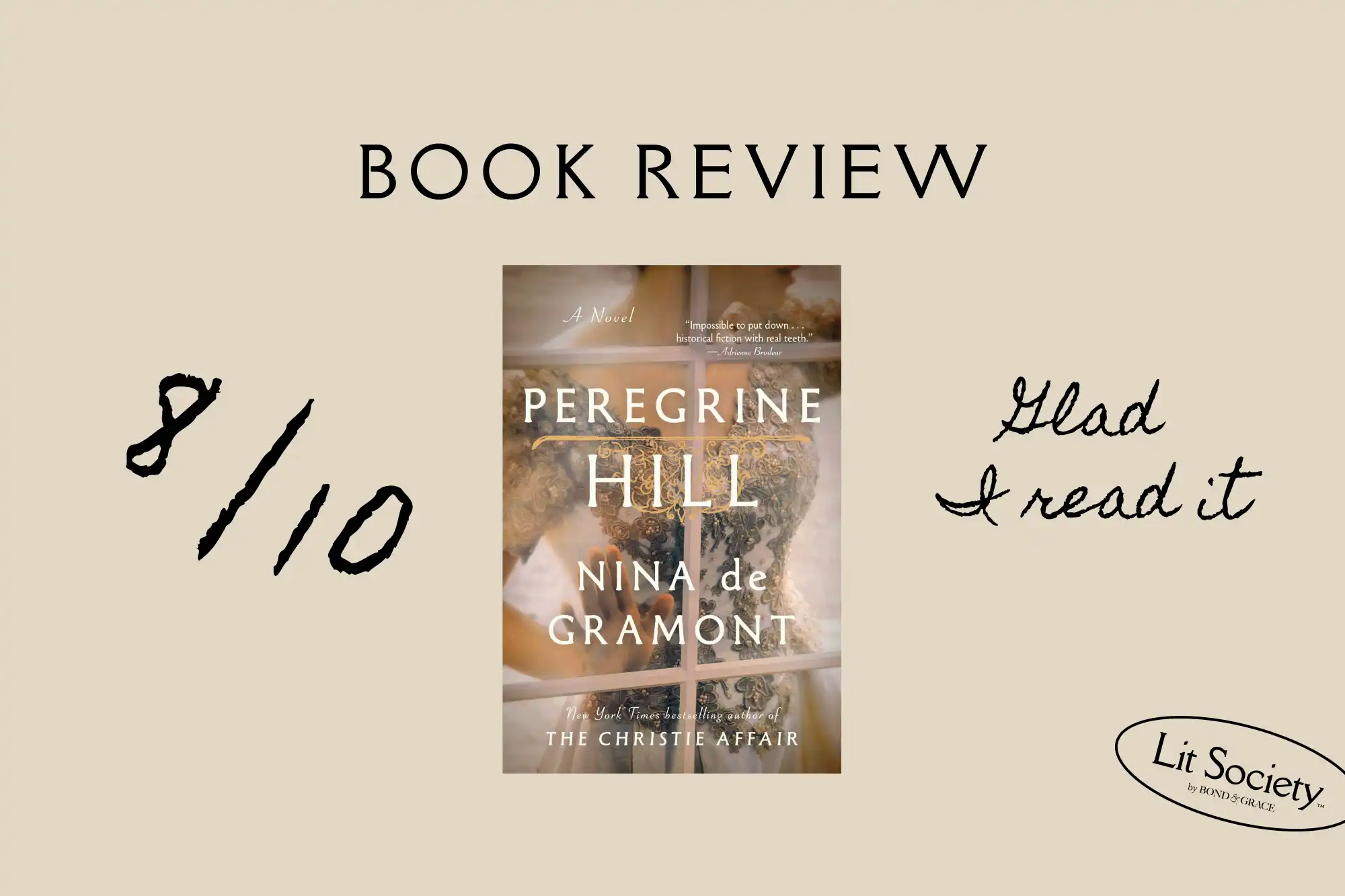
“In this family, we marry for love.” So goes the family motto in Nina de Gramont’s Peregrine Hill (Simon & Schuster, November 10), a novel that recalls Edith Wharton from its opening pages. Like Wharton’s The House of Mirth, de Gramont’s Peregrine Hill is a Gilded Age story of women caught between love, duty, financial survival, and the rigid expectations of society. For the women at the novel's center, their family motto soon proves a bitter irony.
The novel opens at the turn of the century in Hoboken, New Jersey, with Isabelle Bishop; her mother, the Countess de Forge; and her daughter, Mariah, all reeling from a recent tragedy. Having fled across the river from New York, the trio is trying desperately to outrun scandal and financial ruin. Isabelle, cunning and beautiful, believes she has solved their troubles by catching the eye of the fabulously wealthy John Whitten, who, at sixty-three and twice widowed, is desperate for an heir. However, the elder gentleman has set his sights on Isabelle’s eighteen-year-old daughter, Mariah. And he will have her at all costs.
Gramont’s greatest accomplishment is her portrait of the fraught relationship between mothers and daughters. Isabelle loves her children deeply and mourns those she has lost on every page—yet she also sacrifices her last surviving child for her own comfort. Mariah, traumatized by the loss of her siblings and father, in turn severs ties with her last living parent. We watch both women as they justify their choices and then live with the consequences. Some of us may see more of ourselves, and of our own mothers, on the page than we would find comfortable.
Mariah’s lady’s maid, Hetty, provides a parallel story. Her father is a failed but ever-hopeful author seeking ascendancy among the literary greats of the age. Her mother, who works herself to the bone to support the ungrateful man and their daughters, warns Hetty not to make the same mistakes when love threatens to blind her, too. Through marriage and work, respectively, Mariah and Hetty take up the mantle of the men of the family, financially supporting their households despite their limited ability to move, act, or exert power in society.
Gramont’s extensive historical research is evident throughout the novel, from descriptions of early automobiles and the growing popularity of football among the collegiate set to mentions of contemporary literature and the addition of police matrons to the NYPD. At times, however, characters reference titles like The Scarlet Letter and Tess of the d'Urbervilles in an on-the-nose manner, announcing parallels the reader has already recognized.
My one reservation is that the ending of Peregrine Hill feels somewhat rushed. Instead of allowing us to sit in anxiety with Hetty and Mariah during a pivotal point of intrigue, the novel devotes significant time to a fortune teller who adds little to the plot beyond heavy-handed metaphors and symbolism. Still, I closed the novel from the comfort of my own home, where I require no man to protect my reputation, dictate my movements, or grant me freedom, and toasted to women like Mariah and Hetty.
Favorite Lines?
“Charm never saved a single human being, no more than kindness, or beauty. Money, though. That was an unflagging lifeboat.”
“Evidence of doomed lovers lurked everywhere, but she refused to believe they had anything to do with her.”
“A small voice called out from another world: You’ll lose everything.
Everything’s already lost, she responded. And allowed herself, instead, to have this.”

Recommended Media?
🎵 “Last Great American Dynasty” by Taylor Swift — I can see Hetty and Mariah dancing along to this melodious anthem of wealth, independence and the subtle art of indifference to scrutiny.
📺 The Gilded Age — Why not turn back the clock and watch as the upper crust of New York society also navigate financial disaster, love, and complex relationships amongst women?
Interested in purchasing Peregrine Hill? Support Bond & Grace and purchase the book via Bookshop here.