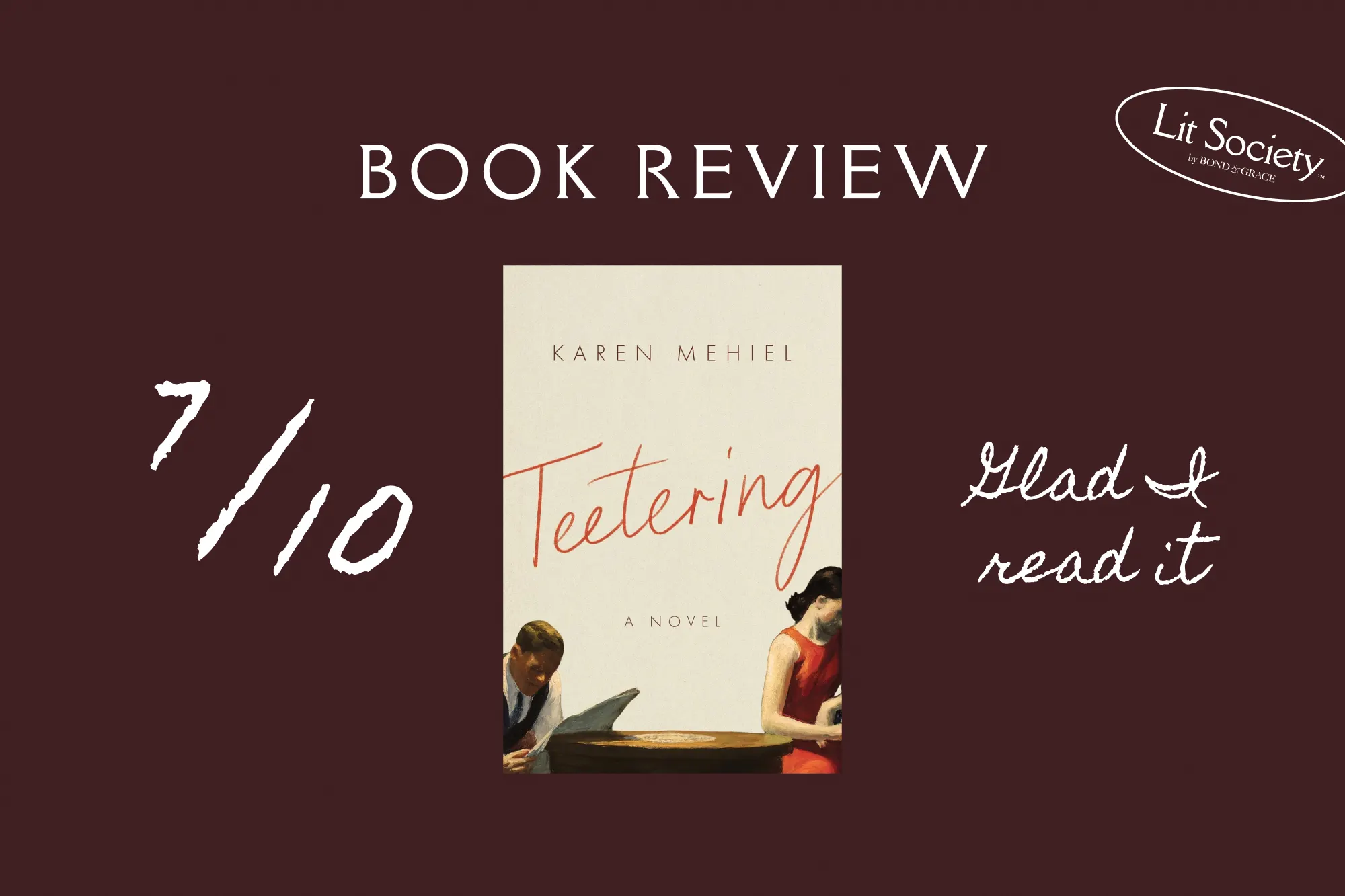
As part of Lit Society’s Book Review Program, members are reading and reviewing books by independent writers we think deserve more attention. This review reflects one reader’s honest experience and aims to spotlight exciting new voices.
Big Take? A powerful reflection on what truly constitutes a “successful” life. Will resonate with fiction readers who appreciate strong character development, intimate examinations of relationships, and narratives that weave back and forth through time.
The Verdict? 7/10, Glad I Read It.

● Would You Recommend It? Yes
● Book Club Worthy? Yes
● Would You Read This Author Again? Yes
● Did It Change How You See Something? No
● Is It More Plot or Ideas? Ideas
● Pace: Steady
● Emotional Impact: Lingering
● Best For: Deep thinking and reflection
● Skimmable or Demands Attention? Close Reading
● Would You Reread It? No

In a time when increasingly unrealistic expectations are imposed on women, Teetering by Karen Mehiel urges us to embrace our flaws and vulnerability rather than lose ourselves in the quest for perfection.
The story centers on Allegra, a woman who appears to have a storybook life: a thirty-five-year marriage to her husband Sam, the comforts and privileges of the upper class, and a close family. It hasn’t been easy; Allegra has made many compromises in her relationship with Sam, a successful businessman with strong political influence who is often distracted with work, inherently selfish, and always “right.” While Allegra actively pursued the life she has—beginning in childhood, when she decided she “would just have to grow up to be rich”—she’s spent her life navigating the tensions between her middle-class roots and privilege; her solid family bonds and Sam’s sometimes blasė approach to relationships; and a strong work ethic with feeling purposeless.
As Sam’s eightieth birthday approaches, Allegra plans a lavish surprise celebration and decides to chronicle their life together. But as someone who equates creating perfection with showing love, Allegra’s convinced that her new secret could destroy everything. She’s torn between revealing the truth and her default mode of numbing her feelings with Xanax or alcohol and carrying on as though everything’s fine. As Allegra authors the story of her and Sam’s relationship, she reflects on the choices she’s made—many governed by the desire for control and perfection—and realizes the life she worked so hard to create provided only the illusion of control and has left her feeling empty.
Mehiel’s writing craft choices magnify the novel’s conflicting themes of control and surrender, class status and purpose, and external validation and true connection. The author took a unique approach in the use of tense, employing the present tense during memories and backstory, and the past tense during the present. The effect can be confusing; the novel jumps back and forth, and it’s sometimes tough to discern where the scene you’re reading falls in the timeline. But the use of present tense for previous periods of time creates a powerful and unique effect that’s similar to watching a film montage, and you feel as if you’re standing alongside Allegra and Sam at various points in their life.
Similarly, Mehiel switches between first person point of view in Allegra’s memories (“Sam has always been and always will be my drug.”) and third-person during the present (“Their love was exceptional, and she would do whatever was necessary to keep it strong.”). As a result, readers feel removed from Allegra in the present, mirroring the disconnection she feels from herself and her current life.
While Mehiel’s creative use of point of view and tense amplify the novel’s tension, other choices take away from it. Mehiel weaves cultural context into her flashbacks which often feels irrelevant and abruptly removes readers from the story and characters. Some instances, such as a critique of modern parenting, feel soapbox-y. One particular example, a commentary on increasing homelessness and healthcare disparities, which is immediately followed by Allegra’s frustrations with the inconveniences of her temporary two-bedroom, two-bathroom rental in an affluent Manhattan neighborhood, makes Allegra downright unrelatable. When it comes to cultural context, only Mehiel’s meditations on COVID seem essential to the story. In recalling how leaders in disease prevention had been predicting a pandemic for years, Allegra muses, “People preferred to tune out, until they had no choice and everything screeched to a halt.” This observation is both a powerful metaphor and foreshadows what’s to come.
At its core, Teetering is the story of a woman who lost herself over time but now feels the pull of her cultural roots and deep-seated values. For anyone who’s reflected on the choices they’ve made, the paths those decisions paved, and who they are now versus who they want to be, this novel will resonate. It’s a powerful reminder that relationships, like cultural measures of success, are ever-evolving, but the basic principles remain: love and connection—with others and yourself—will always triumph.

Favorite Lines? "Am I living the life that is expected of me, the voice asked, rather than the one I want?”
“The drive to be the perfect wife, the flawless mother, the woman who juggles everything without ever letting a single ball drop—it had left no room for the raw, unfiltered version of her.”
“Sifting through old memories felt like standing in an overstuffed closet, trying to determine which things still fit and which she should just let go.”

Recommended Media? “Landslide” by Fleetwood Mac, Three Days in June by Anne Tyler, and “Scenes from a Marriage” (HBO)
Interested in reviewing books for Lit Society? Join our growing team of member reviewers and help champion independent authors and unforgettable reads.