
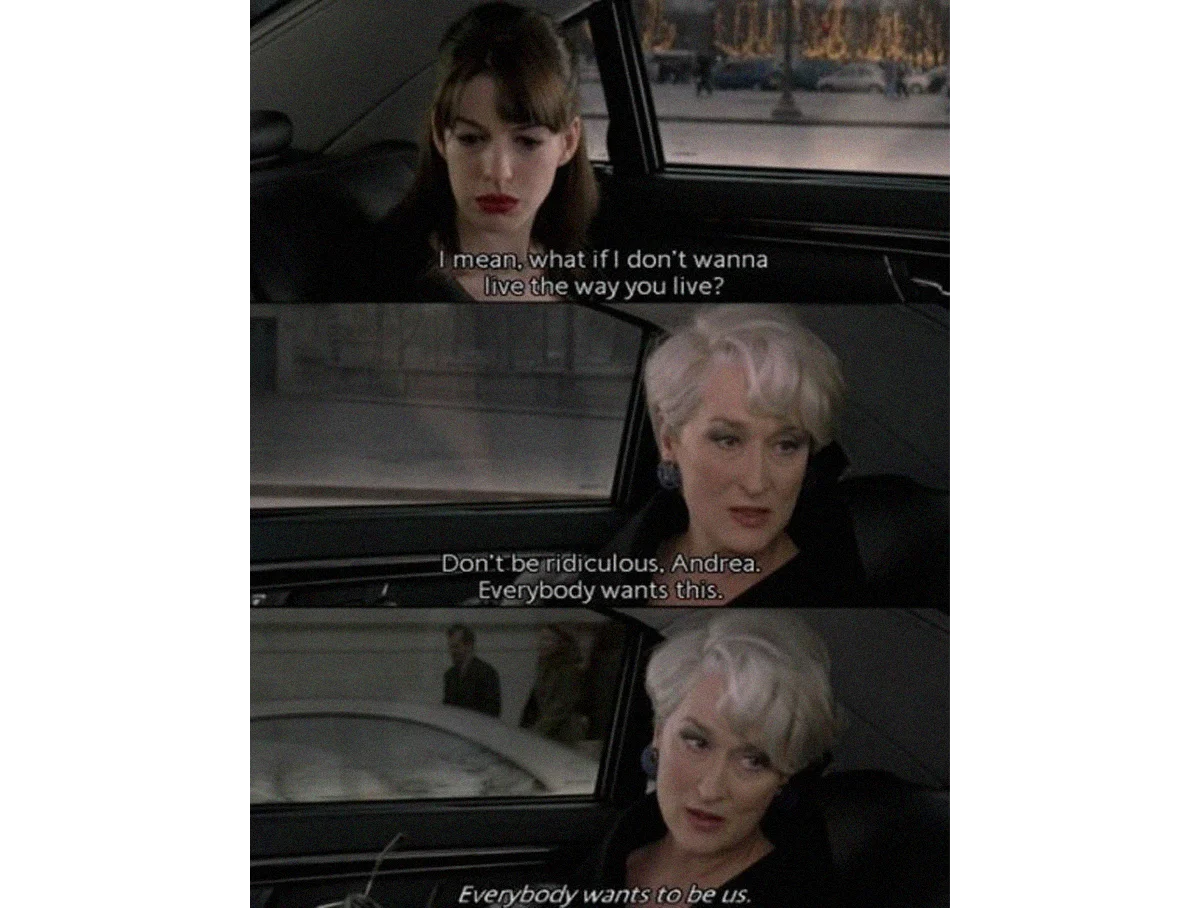
“Oh, don’t be silly—Everybody wants this. Everyone wants to be us.” This iconic line from the film adaptation of Lauren Weisberger’s 2003 novel The Devil Wears Prada comes toward the end of Andrea’s tenure at Runway. Finally, she voices the doubt that has followed her throughout the course of the story: whether she is willing to make the personal sacrifices the job demands. Her demanding boss Miranda dismisses that hesitation with a scoff, treating it as absurd. The implication is not that the job is easy or kind—it is clearly neither—but that the question of whether it is desirable has already been settled. Wanting to be close to power is assumed to be natural, even inevitable, and the suffering attached to that proximity is understood as part of the exchange. In this framing, the personal costs of ambition are assumed to be acceptable. They don’t require justification.

For much of the late twentieth and early twenty-first centuries, fiction about women and work reinforced this logic. Ambition was portrayed as punishing, often cruel, but ultimately purposeful. The labor—physical and emotional—demanded of women might be excessive or demeaning, but it was framed as formative. Endurance promised independence and a more fully realized self. Even toxic systems were rendered understandable, their harms softened by the assurance that something meaningful waited on the other side.
What has shifted in more recent literature is not merely the tone of these stories, but their faith in the payoff ambition once promised. Contemporary novels increasingly question whether striving toward success, status, or professional identity still offers young women a reliable sense of meaning, or whether it has become a source of exposure and exhaustion that gives little back. The certainty embedded in Miranda Priestly’s declaration begins to look less like truth than assumption, a story inherited from an earlier era, when the goals women were encouraged to pursue still seemed capable of delivering a stable, satisfying life.

The Old Bargain: The Cost of Personal Ambition
In The Devil Wears Prada, success comes with a clear set of costs. Andrea can climb the publishing ladder, but only once she relinquishes her comfort, autonomy, and personal life. That this bargain is presented as realistic rather than exaggerated is no accident; Weisberger loosely based the novel on her own experiences as an assistant to Anna Wintour at Vogue. Andrea is expected to be available at all hours, absorb public reprimands without protest, and accept that her time and relationships are secondary to the job. Neither the novel nor film adaptation denies the cruelty of this system. Instead, it frames endurance as preparation, suggesting that what Andrea survives here is what qualifies her for whatever comes next.
That same logic structures The Nanny Diaries (2002) by Emma McLaughlin and Nicola Kraus, also loosely based on the authors’ experiences, this time as nannies to Manhattan’s social elite. The setting shifts from publishing to domestic labor, but the underlying bargain remains familiar. The job is emotionally invasive and physically exhausting, yet the narrative treats it as instructive. Nanny Schuester gains clarity about the life she does not want. When she leaves, she does so not in rejection, but in completion.
What unites these texts is their faith in conversion. Pain is expected to yield insight. Toxic environments are framed as character-building rather than disqualifying. Even abusive bosses are often contextualized as women who have paid steep personal prices for authority. The work may be punishing, but it still promises transformation. Enduring it, however costly, is presented as a rational choice.
The Collapse of Work as Identity
That perspective only held as long as sacrifice reliably delivered something in return. From the mid-to-late aughts, that began to collapse. Assumptions that had once felt solid—job security, upward momentum, a clear sense of arrival—started to lose their credibility.
The 2008 financial crisis acted as a catalyst for this shift. After decades of loyalty, people lost jobs, savings, and retirement plans almost overnight. Entry-level hiring froze. Unemployment rates skyrocketed. Industries that had once absorbed young workers—publishing, media, fashion, academia—cut jobs and stopped hiring. An entire generation of millennial graduates entered the workforce through unpaid internships and temporary contracts. Even “good” jobs came with the understanding that they could disappear without warning.
As the promise of stability eroded, so did faith in employment as a source of identity. Hustle culture and the commercialization of passion redirected ambition inward, urging people to monetize hobbies, brand their personalities, and treat the self as a perpetual project. Sacrificing oneself for an employer no longer seemed disciplined or aspirational—it seemed foolish.
Opting Out: Disengaging from the Demand to Perform
Just as the promise of work as identity collapsed, so did the trend of literary heroines willing to endure anything in order to make it. Novels entered an era of cynicism toward the idea that professional suffering was inherently meaningful or worth the cost. Work—sometimes brutal and humiliating, often dehumanizing, but once framed as ultimately worthwhile—stopped functioning as a reliable source of meaning. Fiction began to reflect a growing disbelief that professional sacrifice led anywhere at all.
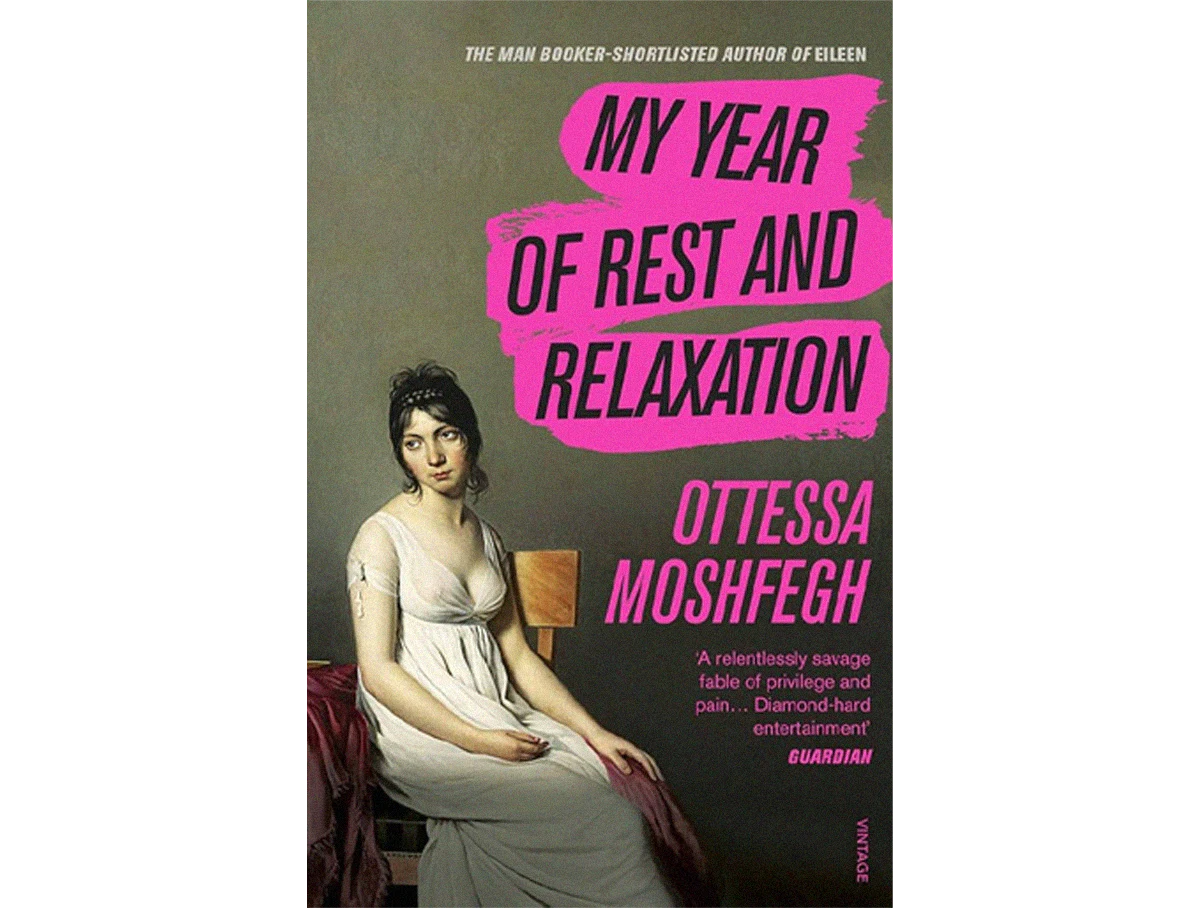
Ottessa Moshfegh’s My Year of Rest and Relaxation (2018) captured that shift precisely. The story follows a young woman living in New York who decides to spend a year almost entirely asleep, chemically sedated and withdrawn from the world. While this unnamed narrator insists that this period of rest will improve her, the novel itself refuses to treat her withdrawal as healing. She is not seeking balance or a healthier relationship to ambition—she wants absence. Not only professional effort, but any effort at all, registers as too exhausting to cope with. What she pursues is not improvement, but suspension.
What distinguishes the novel is not simply the depth of the narrator’s exhaustion, but its source. She is not undone by a single bad job or a set of poor choices. What overwhelms her is the accumulation of ordinary demands: the weight of participation in life itself becomes intolerable. The problem is not something that can be fixed through better boundaries or healthier ambition. It is a rejection of the ongoing effort of existing at all.
The novel is often read as the ultimate burnout story or dismissed as a fantasy made possible by extreme privilege. Both readings are partially true. But even more crucial is Moshfegh’s refusal to give this “year of rest” any meaning. Nothing is learned. No insight is earned. The year does not resolve into clarity, growth, or renewed purpose, and that refusal is the point. Where earlier fiction insisted on converting suffering into meaning, My Year of Rest and Relaxation withholds that conversion entirely.

Work as Erasure: The Cost of Remaining
My Year of Rest and Relaxation functions as a thought experiment: What happens when personal ambition no longer provides a source of meaning, and complete disengagement replaces achievement as the goal? But that experiment depends on a particular kind of insulation. Not all fiction—and not all protagonists—can afford that premise.
Where Moshfegh’s narrator exits the system entirely, other contemporary novels are more interested in what happens when belief in work collapses but participation remains unavoidable. In these stories, meaning drains out of professional life not because characters leave it behind, but because they remain embedded in systems that no longer promise reward and instead expose them to real consequences.
Zakiya Dalila Harris’s The Other Black Girl (2021) takes up this problem by returning to the same industry as The Devil Wears Prada: publishing. Like Weisberger’s Andrea, Nella works in a competitive, status-driven environment where proximity to power is framed as opportunity. But Harris makes clear that the act of ambition itself is more complicated for Nella and other people of color.
In Harris’s novel, the threat is not just burnout or self-sacrifice, but ultimate self-erasure: full assimilation into a system that devalues both your labor and your personhood. She raises the stakes by introducing elements of horror to represent what people of color are required to give up in order to “climb the ladder” and “make it” in their desired field. In this sense, The Other Black Girl clarifies what My Year of Rest and Relaxation introduces. Moshfegh imagines a world where work has lost its meaning and complete disengagement becomes preferable. Harris shows what happens when work has lost its meaning, but participation continues anyway. Together, they mark a shift in how fiction understands professional life. Work is no longer the site where identity is forged through sacrifice. It is the system that demands identity be given up altogether.
Rachel Yoder’s Nightbitch (2021) extends this trajectory at the cost of participation into the body itself. The novel follows a woman who has given up her career as an artist to become a full-time mother and finds herself slowly dissolving inside the role she is expected to inhabit. What she experiences is not exhaustion alone, but a profound loss of self brought on by total identification with care and performative productivity. Her transformation is not a metaphor for balance or empowerment; it is a response to the pressure of being consumed by work and expectation until nothing of the self is left intact.
Together these novels mark a further evolution in how contemporary fiction represents labor and identity. Where Harris uses horror to expose the costs of assimilation within institutions, Yoder literalizes the loss of self by forcing her protagonist to abandon her human form entirely.
Why “Everyone Wants This” No Longer Holds
Recent fiction reflects a changed understanding of work’s role in women’s lives. Earlier stories framed professional self-sacrifice as justified. More recent novels are less convincing—they reflect a growing recognition that the systems women are asked to invest in do not reliably deliver meaning, stability, or protection in return.
Miranda Priestly’s line “Everyone wants this [job],” once sounded persuasive because it echoed a widely held belief: that being at the top justified almost any personal cost. Read now, it feels like a relic of a different era. The fiction that follows does not deny the desire to succeed, but it questions whether work can still be trusted to provide a sense of self at all.