As Buffy Summers staked her claim into our hearts in the 1990s, generations of Slayers saw that a female protagonist could be both smart and stylish. When Buffy the Vampire Slayer ended its seven-season run in 2003, Buffy had evolved into a complex young woman who had loved, lost, fought the Big Bad, and, as her headstone would later read, “saved the world. A lot.”
Following the passing of Anthony Head this past summer, who played Rupert Giles, I’ve been thinking about one of the key lessons his character imparted to us: the importance of libraries, research, and what a good book can do. Sunnydale High's librarian, Giles, understood that books are more than vessels for knowledge. They’re things we hold, smell, spill coffee on, and pass down. And in Buffy, sometimes they’re what help you save the world.
Buffy the Vampire Slayer follows Buffy Summers, a teenage girl chosen to fight vampires, demons, and other supernatural forces threatening her California town, with the help of her friends and her “Watcher,” Rupert Giles. As she comes to understand the weight of her role as Slayer, she educates herself on the supernatural, using knowledge as a weapon in the fight against evil. To understand the forces of darkness she faces, she must first learn their histories.
Buffy’s research, knowledge, and power would be impossible without books.
During the action-packed intro to each episode, we’re introduced not only to the formidable cast behind Buffy’s “Scooby Gang,” but also to her legendary Vampyr tome, the leather-bound Slayer handbook Giles shows her in the series premiere—a guide to the demons and vampires she’s called to fight. It is Giles who opens up the world of occult knowledge to her; later, he becomes owner of the Magic Box, where books and occult artifacts help the Scoobies investigate the supernatural. While his love of literature is apparent from the start, the episode I, Robot... You, Jane (Season 1, Episode 8) offers a particularly revealing glimpse into his attachment to books not only as sources of knowledge but as physical objects to hold, cherish, and even smell.
Ms. Calendar, Sunnydale’s new computer science teacher, is seen scanning books into Sunnydale High's online database while Giles looks on, dismayed. He intervenes, staunchly asserting himself against digitizing books and launching into a passionate defense of the sensory experience of reading from a physical tome. There is nothing quite like the sensory effect—and associative memories—that come with reading a book. Smell, he argues, “is the most powerful trigger to the memory there is… Books smell musty and rich. The knowledge gained from a computer is… it has no texture, no context. It's there and then it's gone. If it's to last then the getting of knowledge should be tangible. It should be smelly.”
As someone whose personal library spans the 19th through 21st centuries, I certainly agree. My shelves exist somewhere between the brand-new and the very old, holding everything from newer reprints to a handful of first editions with deckled edges and still-uncut pages. Many of the books in my collection have yellowed with age, their pages fading, dog-eared, and stained with coffee mug rings. Others smell of ink fresh off the press, their spines gleaming. And then there are my favorites, mysterious notes annotated in the margins, either barely legible or half-finished thoughts that have left me stumped. This is the tangibility Giles is addressing. Don’t get me wrong, the smell of a brand new book entices, but an old book? Well, that smell is distinct and unforgettable. So specific, so transportive that there's a science behind it—bibliosmia.
Bibliosmia describes the very smell Giles champions in this scene, the unique aroma of antiquarian books. Over time, the cellulose, lignin and various other chemical components in a book’s paper break down (turning that tea-stained yellow), while the materials used in printing and binding also contribute to its aging scent. In short, bibliosmia is the chemical death of a book as it's caught slowly dying.
Even more special is the thought that each book decays differently. Think of the oldest one you own: that distinctive scent can never be replicated or replaced. But antiquarian books hold more than the traces of chemical breakdown; they also carry the memories of previous owners.
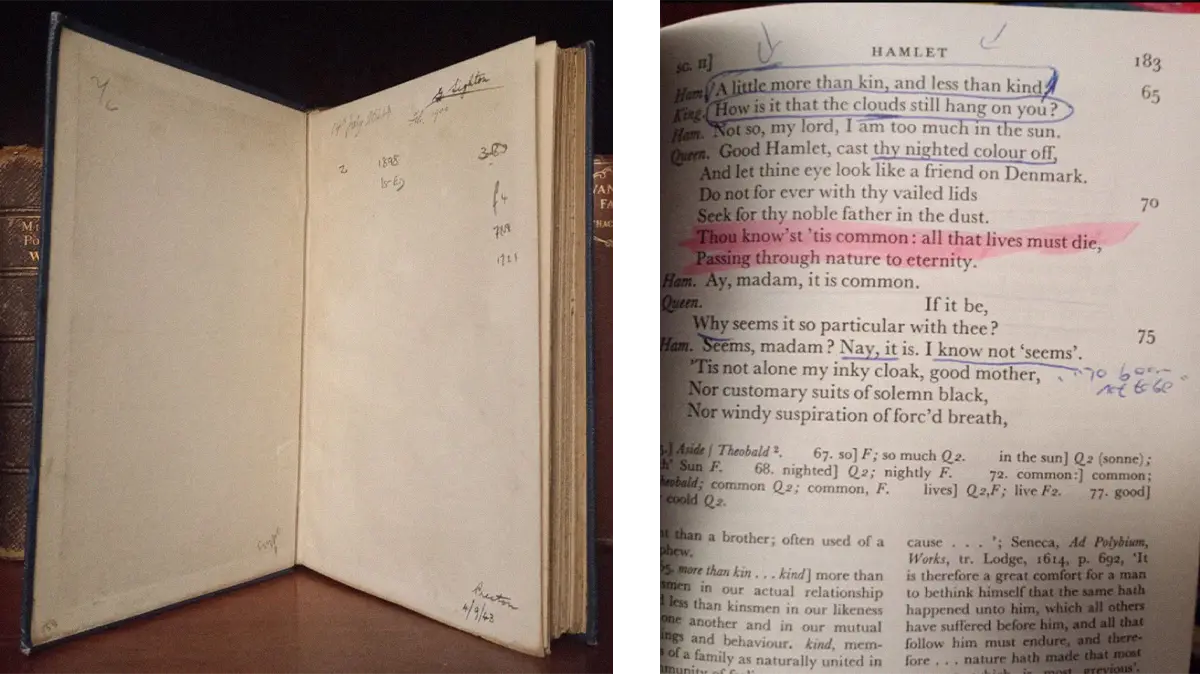
As Giles puts it, “A certain flower, or a whiff of smoke can bring up experiences long forgotten.” And that includes you, too. Your fingerprints, the way you handled the book as the ideas floated through your mind—it all leaves an indelible imprint on the object in your hands. Maybe it’s from the perfume you wore or the flowers you once pressed between the pages. A drink spilled, your roommate's cigarette smoke, grease from a salty snack lingering on your fingertips. Histories and fictional worlds aren't just in the pages; they're on them, too.
As usual, Giles is right: the search for knowledge is a tangible pursuit. And while the pages carry vast amounts of knowledge, they also emit a wealth of history, just as old as the information and stories they contain. Many of Buffy the Vampire Slayer’s villains have existed for centuries, and the books the Scooby Gang consults often hold histories just as old. Yet the series doesn’t reject technology altogether: the Scoobies turn to computers for research and encounter cyborgs and tech-manipulating villains along the way. In fact, in 2002, the series made TV history as the first show to reference Google and the concept of “Googling,” too.
Airing as the world entered a new millennium, Buffy cast Giles as a skeptic who consistently criticizes technology and calls it a “useless fad.” He faces the horrors of the supernatural daily, yet technology seems to unsettle him even more: “if it were a nice ogre or some such, I'd be much more in my element.” For Giles, monsters are familiar territory. Their histories, behaviors, and weaknesses can be studied and understood through the wealth of books he knows so well.
Buffy the Vampire Slayer left an impression on me not only for its supernatural world, but for the way its story—and the stories within it—rely on physical media that is increasingly under threat. We must keep Giles’ message alive. Books hold our history: the traditions, stories, and the thousand-year-old inner longings that speak to what it means to truly be human. Without books, we run the risk of losing touch with the very things that make us who we are.
In light of the recent passing of Anthony Stewart Head and cast members Michelle Trachtenberg (Dawn Summers) and Nicholas Brendon (Xander Harris), Buffy makes for an especially bittersweet watch (or rewatch if you already know your way around the Hellmouth). The stories surrounding these actors and their characters live on in memories shared by cast and crew, companion books, spin-off novels, and comic books. Their lives and legacies cannot be replicated; no retelling can fully capture the histories and experiences that made them who they were, both to those who knew them personally and to those who grew up watching them.
So, in a world chasing the next technological advancement and digital trend, where do we go from here? I could easily lie to you, as Giles does, and say it's all terribly simple. The good guys are stalwart and true, the bad guys easily distinguishable with their pointy horns or black hats. The heroes will always save the day. No one ever dies, and everyone lives happily ever after.
I'm paraphrasing from the show here, but beyond the neat resolutions that Hollywood storytellers love, there is truth in Giles' musings on literature. If we keep books alive (because, if you ask me, they’re living beings), then we allow their teachings to stay alive too—extending beyond the pages themselves, in all their tactility and beautiful smelliness. And maybe, just maybe, we can keep the bad guys away, if only for one more day. It's just like Buffy said. “The hardest thing in this world is to live in it. Be brave.”