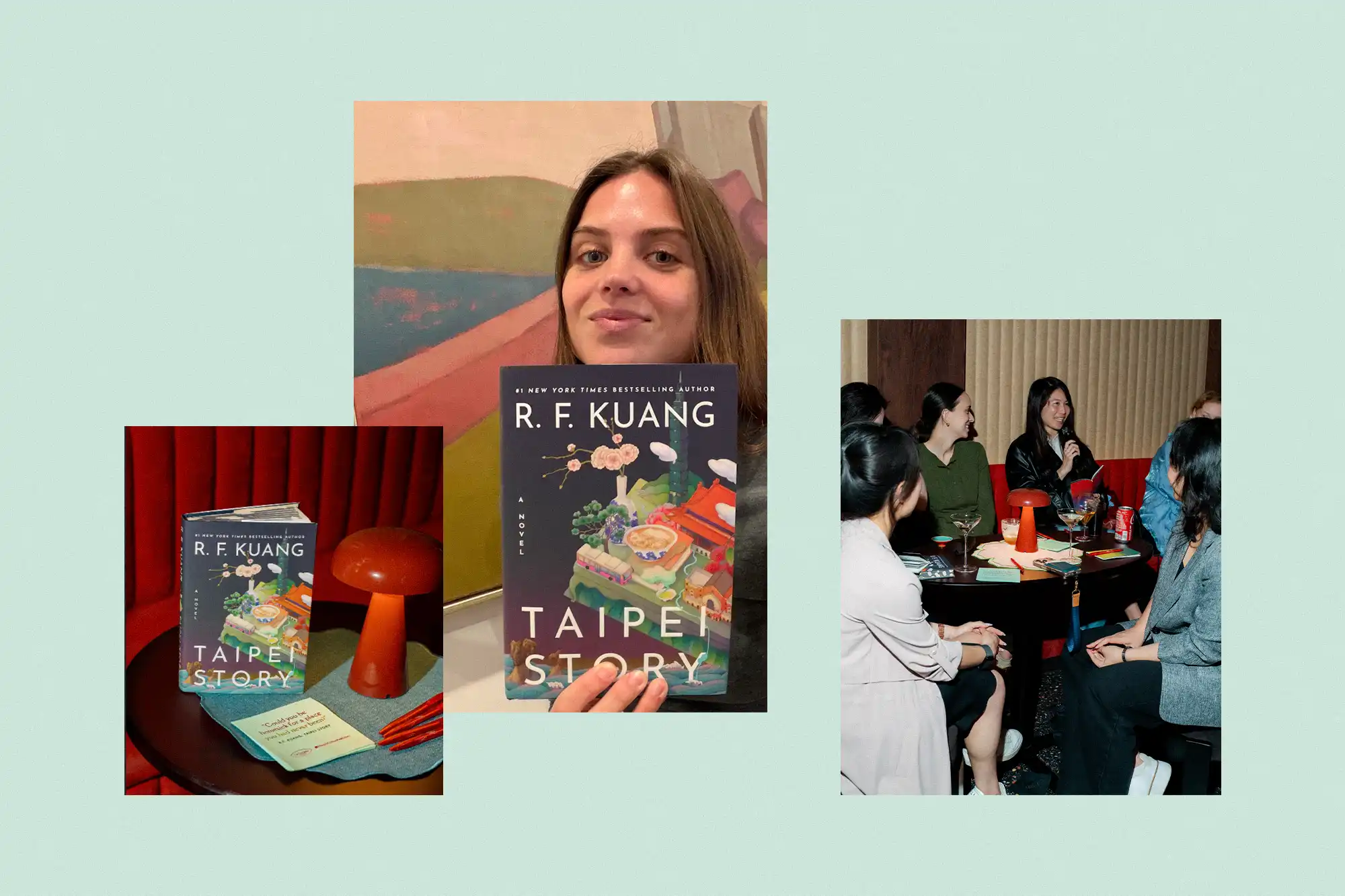
As part of Lit Society’s Book Review Program, members are reading and reviewing books by independent writers we think deserve more attention. This review reflects one reader’s honest experience and aims to spotlight exciting new voices.
Big Take? A witty, intimate slice-of-life novel that follows Lily, a Chinese American college student spending her summer learning Mandarin in Taiwan, hoping to become more fluent at the language, reconnect with her heritage, and converse more freely with her family. But as her plans begin to unravel, what emerges through observational humor, linguistic reflections, and moments of tenderness is a deeply affecting story about loneliness, translation, and grief.
- Would You Recommend It? Yes
- Book Club Worthy? Yes
- Would You Read This Author Again? Yes
- Did It Change How You See Something? Yes
- Is It More Plot or Ideas? Plot
- Pace: Steady
- Emotional Impact: Lingering
- Best For: quiet weekend
- Skimmable or Demands Attention? Close Reading
- Would You Reread It? No

R.F. Kuang’s Taipei Story follows Lily, a first-generation American student at Yale who arrives in Taiwan for a ten-week Chinese language program. Remarkably intelligent, keenly observant, and deeply introspective, Lily is also self-conscious, self-absorbed, and somewhat judgmental. An overachiever all her life, she is confident that the program will bring her closer to fluency and, with it, the prospect of conversing freely with her Chinese grandparents.
What awaits her, however, is a summer that both upends her expectations and challenges the convictions that she relies on to make sense of the world around her. The novel unfolds through Lily's introspections, linguistic reflections, and routine experiences, passages that could have easily become pedantic. Yet Kuang punctuates them with enough wit and personality to keep them engaging.
As Lily begins her immersion program at the National Taiwan University, Kuang weaves Chinese into the prose, occasionally translating Lily's thought processes as she constructs sentences in Chinese. The contrast between her remarkably articulate inner monologues in English and what she struggles to express in Chinese is both striking and amusing. I enjoyed these passages, sometimes learning something fascinating about the language, other times chuckling at one of Lily's caustic remarks. Even when very little was happening, I was quite happy to just inhabit her mind.
As someone who is currently learning Japanese, I empathized with her frustration at not being able to express nuanced ideas in another language and having to settle for a clumsy approximation. It felt like a page out of my own experience. At first, it feels like there are two distinct versions of Lily: one who speaks English, and one who speaks Chinese. As she gradually becomes more adept at constructing her thoughts in Mandarin, however, these versions of herself begin to fuse.
As the summer progresses, Lily's relationship with her roommate, Anna, deteriorates, and salacious rumors following a visit to the hot springs with a male friend leave her increasingly isolated. Amid the loneliness of culture shock and her falling out with Anna, she receives word of her grandfather’s passing, extinguishing her hope of one day conversing with him in Chinese. She tries to come to terms with these experiences the only way she knows: through stoicism and rationalization. Yet these familiar methods seem to fall woefully short.
One moment during this series of events stayed with me in particular. A classmate who helped spread rumors about her visit to the hot springs makes an awkward joke about her grandfather's funeral, hoping to make her laugh. The joke falls flat, but the simple gesture of kindness seems to get through to Lily. She embraces him and breaks down in tears. I was reminded of my own struggles after leaving the comfort of my home in Chennai, India, for the United States—of the loneliness of being so far from anything remotely familiar, and the importance of connection, however tenuous.
During these moments, Kuang lets Lily's experiences speak for what she struggles to articulate. She grows curious about her family's history, finds transcendental solace in music, and continues learning Chinese, as though to keep some part of her grandfather alive. Language, which initially feels like a barrier between Lily and the people she loves, gradually becomes a way of understanding her family and herself.
While the book has no neat resolution, there is something deeply poignant about Kuang’s portrayal of Lily’s experience in Taipei. Despite the culture shock, grief, strained friendships, and frustrations of learning another language, Lily’s inner dialogue never feels overly heavy or exaggerated. By the end, it is difficult not to root for her. For all her achievements, she is simply a young woman, far from home, grappling with a loss that no amount of introspection or analysis could prepare her for.
Favorite Lines?
“Parents died, and people understood if this wrecked you for a year, for many years. Grandparents died, and it was very sad, but that was just a part of growing up. You were supposed to walk it off.”
“I have always been ashamed of my Chinese self,” I said. “She was too young, too immature, too inarticulate. Basically she was an idiot. I wanted to keep her hidden inside classrooms– inside a safe learning space– until she had caught up to me, until she wouldn’t embarrass herself by opening her mouth. But as time went on, the gaps between my two selves never got any smaller, and I was so ashamed, I didn’t let her speak until it was too late."
“So long as I locked my door and put on my headphones, I could make the rest of the house melt away and pretend nothing else existed, that the muffled thumps from below were hallucinations, and that the entire world was limited to the things inside my bedroom: my bed, my desk, and my books. I would stay until the danger had passed.”

Recommended Media?
🎵 "Holocene" – Bon Iver
🎵 "Saturn" – Sleeping at Last
🎵 "Space Song" – Beach House
🎵 "Liebesleid (Love’s sorrow)" – Fritz Kreisler (arranged by Sergei Rachmaninoff)
🎵 "Bénédiction de Dieu dans la solitude" – Liszt
📺 Lost in Translation
📖 Asleep – Banana Yoshimoto
Interested in purchasing Taipei Story? Support Bond & Grace and purchase the book via Bookshop here.