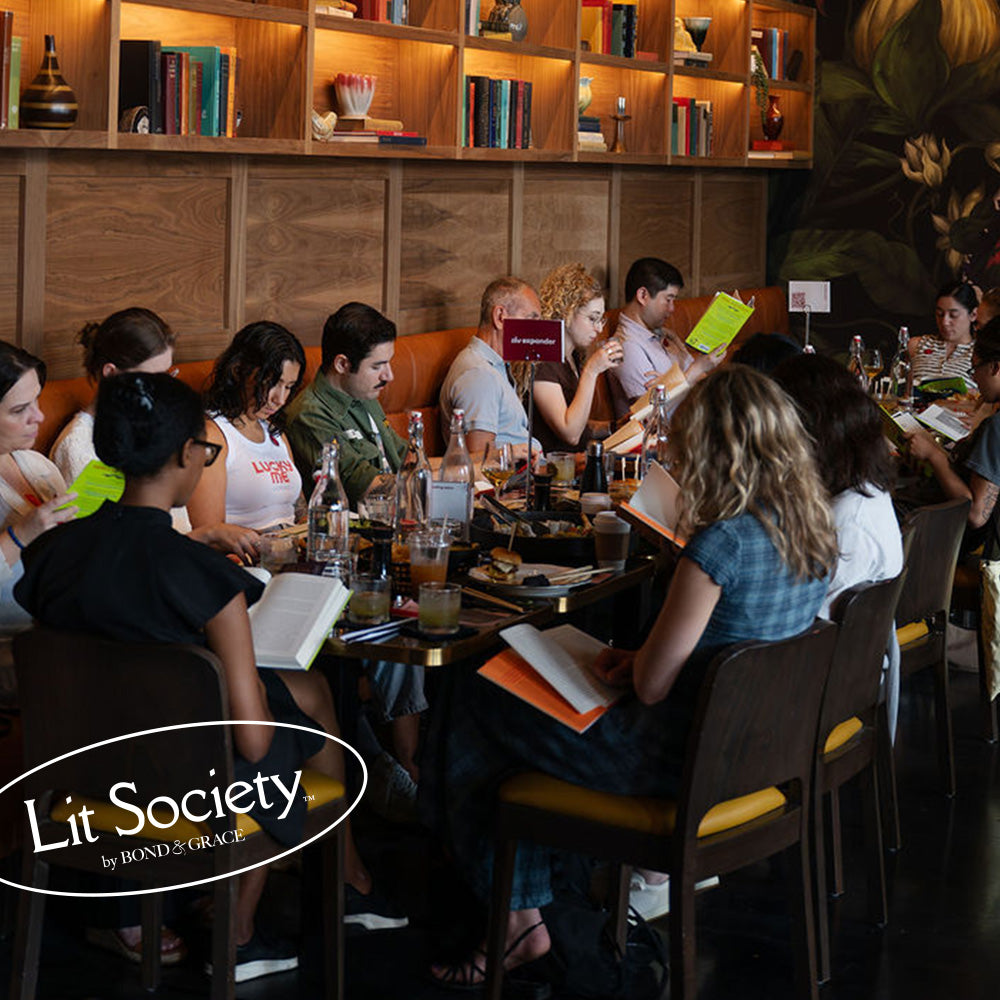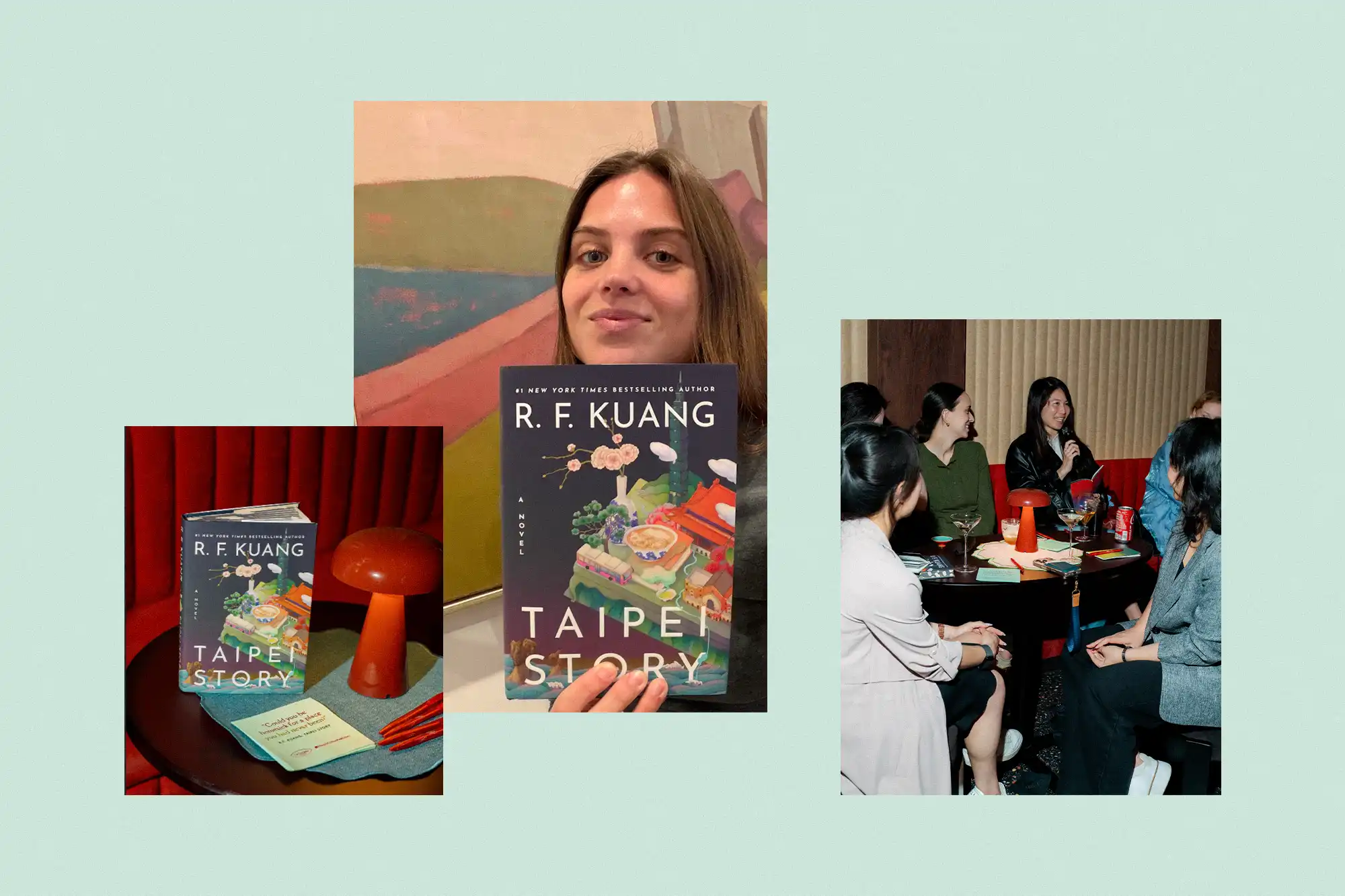
Lit Society hosted a Featured Literary Salon a couple of weeks ago at the delightful Midtown cultural center and Taiwanese restaurant Hue House, in partnership with William Morrow, to celebrate R.F. Kuang’s latest bestseller, Taipei Story. I attended as part of the team producing the event, but I didn’t quite realize how much the salon-style conversation around diaspora identity and the Chinese language, led by Editor May Chen and our Founder Jacqueline Bond, would stay with me.
I have no ethnic origin (that I know of) farther east than Poland, and I’ve lived in relative proximity to Virginia, where my family traces back too many generations to count, for three-quarters of my three-decade life. But like the novel’s self-conscious and determined narrator Lily Chen, I spent the bulk of my childhood—from ages three to twelve—crafting a third-culture identity in Hong Kong, a place entirely foreign to my parents when my dad was first offered a job overseas in 1996. His brothers, who had never left the country, let alone possessed a passport or could locate Hong Kong on a map, balked: “You’re moving where?!?!” Well, they’d just have to put two and two together, because it would soon become the only world, culture, city, and life their brother’s children knew.
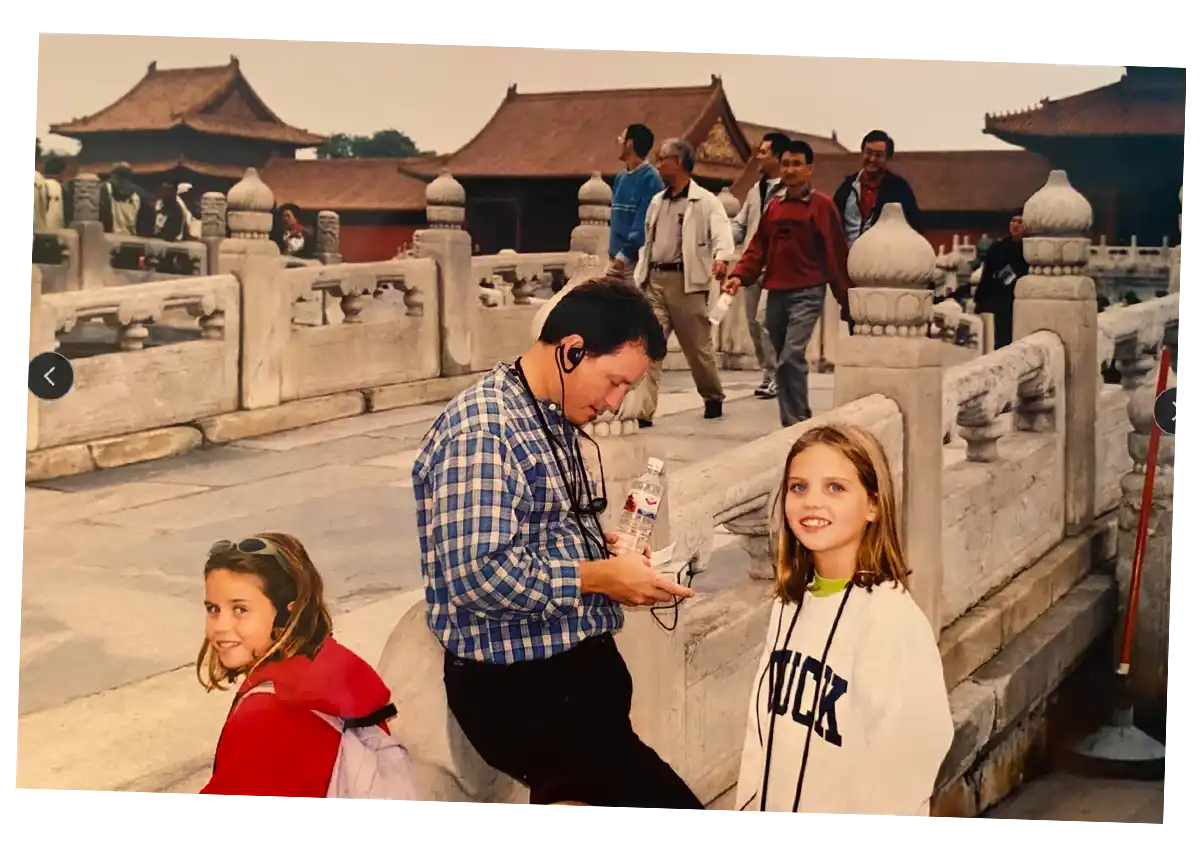
For eight years at Hong Kong International School, I spent Chinese class realizing as Lily put it in the novel, that there is “no systematic way to learn Chinese.” Beginning in preschool and building upon that foundation in later years, our teachers introduced us to the language through simple characters made from singular components, such as 大 (dà), meaning “big,” and 爱 (ài), meaning “love.” These characters became so ingrained in me that a teacher writing 大 on a whiteboard remains one of my earliest memories. As a five-year-old, I pranced around the room with Chen Laoshi, dancing to Chinese nursery rhymes such as 两只老虎 Liang Zhi Lao Hu 两只老虎 (“Two Tigers”), unforgettably sung to the tune of Frère Jacques.
Here we were: international children from Switzerland, India, Malaysia, Canada, and beyond, all grouped together by the strange current of happenstance, learning Mandarin—a language we could not use to communicate with the Cantonese-speaking locals around us, and one that, for most of us, had no connection to our family histories. While I might have needed to master the language to understand the origins of the culture around me, I didn’t need to master it to understand myself.
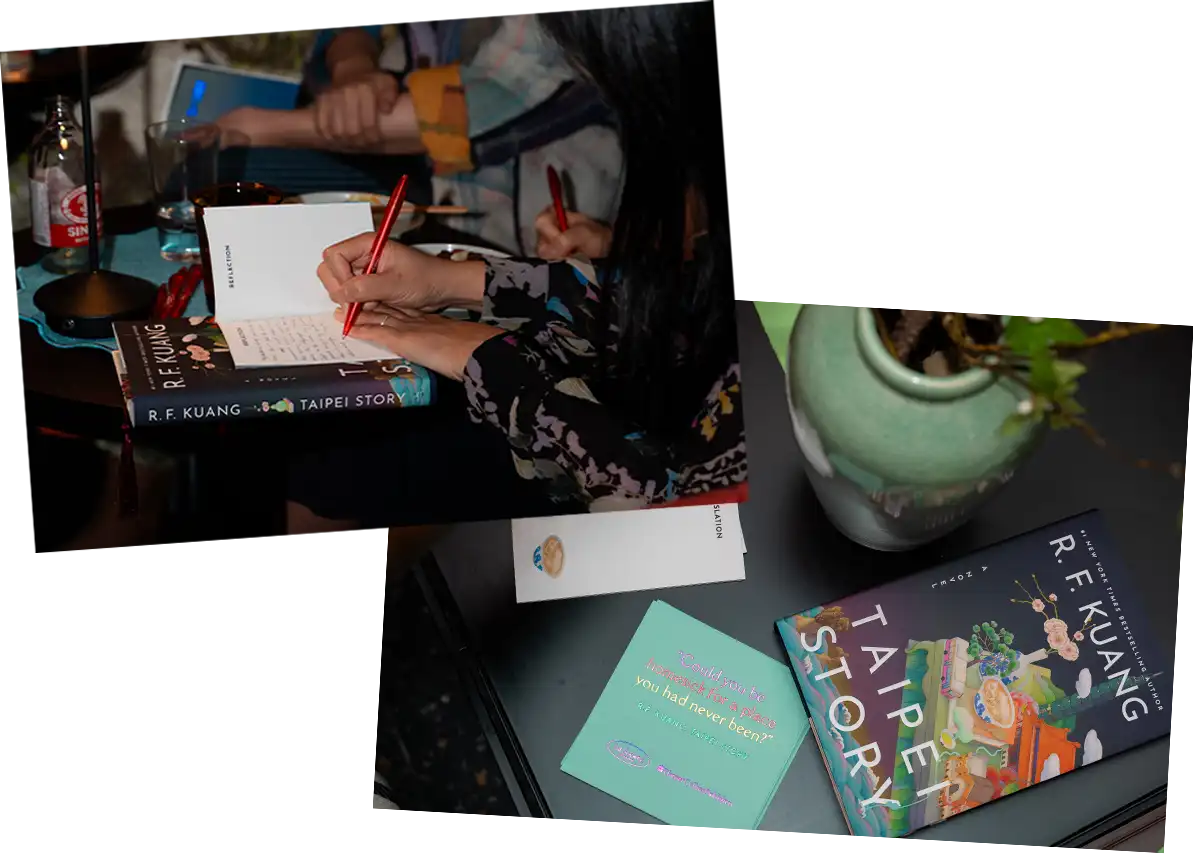
Lily Chen, of Taipei Story, finds herself in very different circumstances. A first-generation American student studying at Yale, she goes to Taiwan for the summer to attend an intensive, 10-week Mandarin immersion program—not for the self-satisfying reward of achieving fluency, but out of necessity: to be able to communicate with her parents and grandparents in their native tongue. To situate herself within their history, one that divulges itself through the novel’s twists and turns. But Lily soon realizes that studying in Taiwan is offering her a backward route through Chinese history: Her parents haven’t been to Taiwan, and her grandparents are themselves products of a history of migration and displacement that stretches far beyond the island—to Guangzhou, to Cambodia, and through the upheavals that scattered her family across Asia. Taiwan is not an ancestral home for her at all, but a third place with its own complicated history, shaped by the rupture between Communist and Nationalist China, and located 500 miles away from Guangzhou, where her parents were raised.
It will take her until the end of the book—and, spoiler alert, the death of her 公公, “gōng gong,” or grandfather—to realize that what she set out to achieve is even more complicated than the near-impossibility of mastering Chinese. To sound like a native Mandarin speaker and to “become Chinese… on my own terms,” not in the mainland but in Taiwan—a place “friendlier to American travelers,” with a program chosen because “all” of her friends had chosen it first—presents unforeseen challenges. She is the only one among her peers with Mandarin-speaking parents, and as she tries to patch the “shocking foundational gaps” that accompany “heritage-speaker advantage” in a place that “had nothing to do with me,” she finds herself caught in a crippling cacophony of confusion, frustration, anger, and isolation.
Fatigued, exhausted, and headache-ridden in the haze of culture shock merely weeks after her arrival, she imagines “getting up and going outside… and the thought made me wilt.” Kuang describes Lily’s disorientation with precision, written through the lens of the narrator’s self-conscious, perpetually questioning mode of narration: “as it was, I felt trapped inside my skin, and all my irritations simmered underneath with nowhere to go.” Jealous of anyone with the privilege of studying a language “just because it was foreign” Lily asks her reader, with characteristic frustration, “Imagine studying a language that only represented difference. History that felt like fiction. Vocabulary that didn’t unlock memories of shouting in the night. What would that be like?”
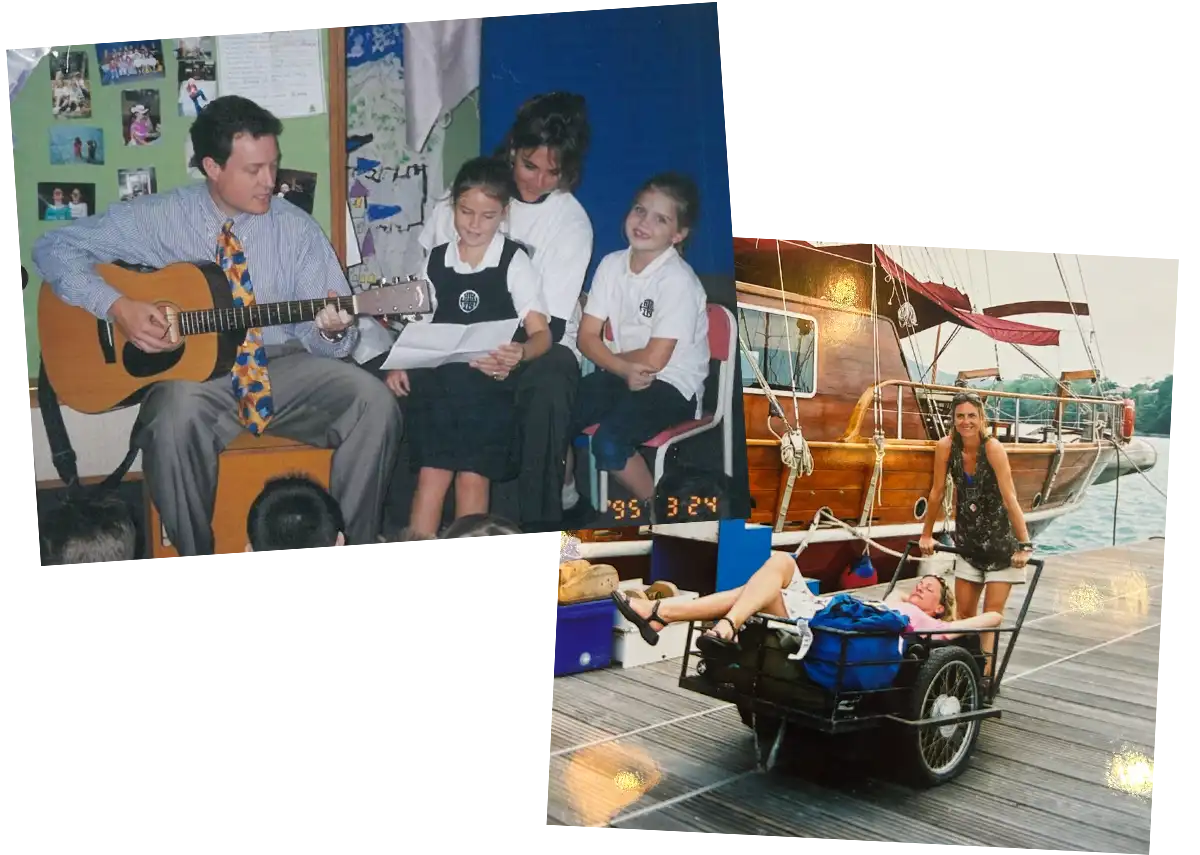
Well, I can tell you from personal experience: it came with a lot less pressure. Part of me wishes I’d had the motivation Lily Chen has to master the language, but the truth is that my immersion experience came not with the “shame” of “diaspora adolescence,” as she puts it, but with pride—and quite a bit of fun. I spent my childhood eating mooncakes and counting down the days to Hong Kong’s annual Mid-Autumn Lantern Festival, held on the beach at the end of the street where I lived. When that passed, it was Buddha’s Birthday to celebrate—a public holiday—followed by Chinese New Year and Hong Kong’s annual Dragon Boat Festival. The celebrations seemed never to wane. The year before we left, during my first year of middle school, I learned traditional Chinese waist drumming, or yaogu (腰鼓), as a credited elective.
I was never trying to become Chinese, nor did I feel any pressure to fully assimilate. Instead, Hong Kong International School (HKIS) embraced all of our cultures and identities, celebrating them each year on “International Day,” when we were asked to dress in clothing from our respective countries and bring food native to our cultures (think cowboy boots and red-white-and-blue cupcakes). Chinese culture was not something I had to seek out or prove my connection to; it was simply part of the world I grew up in.
That pride followed me home to Virginia, where I could say I had experienced life overseas, been exposed to classmates from fifty different countries and territories, as HKIS still to this day boasts, and would one day return to the U.S. with a history and a foundation in a language that offered a certain shock factor, a wow factor—a bonus to my Americanness. Lily’s experience is the opposite; that she doesn’t speak Chinese fluently is the shock, a deficit in her eyes, that she spends the length of the book’s 300 pages trying to come to terms with.
Lily’s experience learning Mandarin as a child is not colored with mooncakes or lanterns but musty hallways, panic, and rote memorization. She recalls reciting Chinese poetry on Sunday afternoons during her Chinese class at community college (“so many recitations") in front of her classmates and parents, like so many generations of Chinese children before her. But, as she laments, “you couldn’t learn Chinese this way. This wasn't a lived language. This was a source of shame, an eye roll, a minute hand ticking through molasses. This was stroke orders traced a thousand times without ever leaving an imprint on our minds, and Tang poetry memories in a blind panic in cold, musty hallways. This was words written on water.”
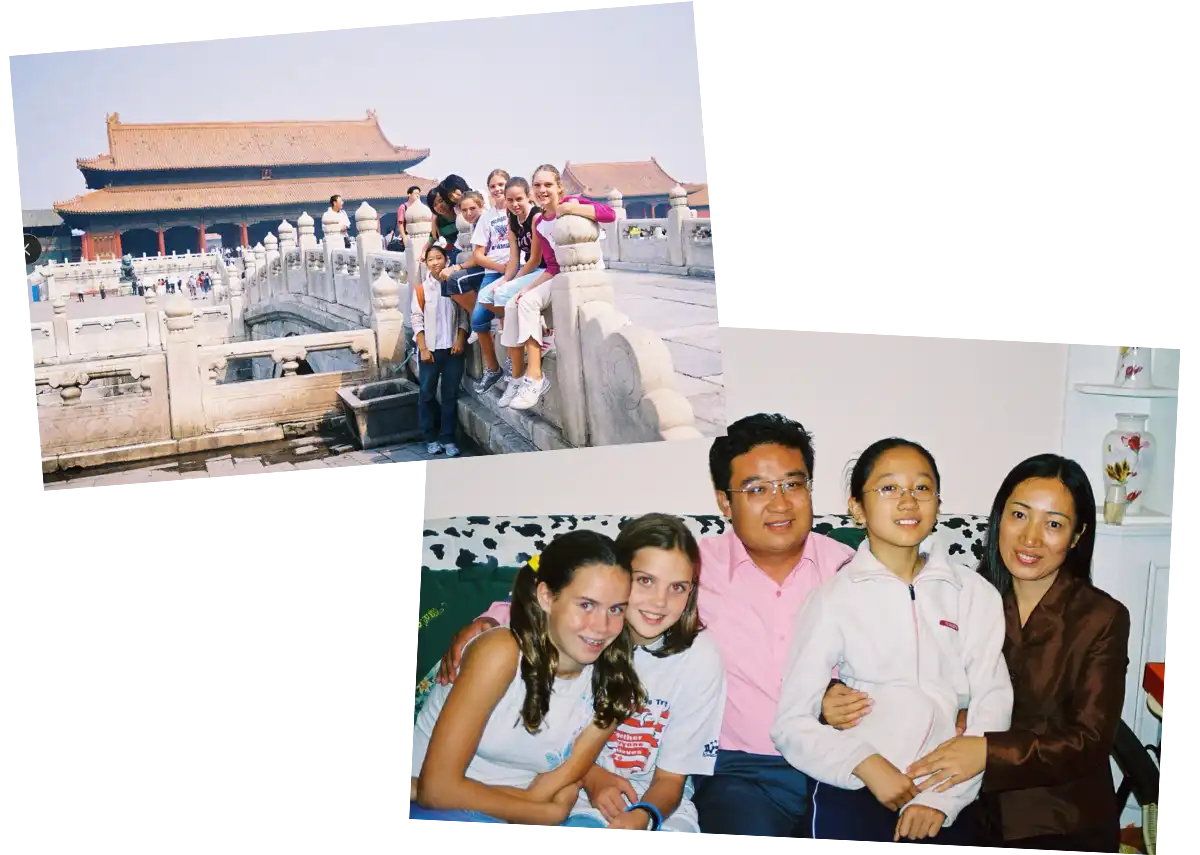
I, too, think about so many hours, days of my life, months even, spent etching characters into tiny boxes on homework worksheets, to the week-long immersion program my sister and I took in Tianjin, China, living with a host family at 11 years old, where I became so homesick that I developed a strange itchy rash that left me like a deer in the headlights in a rural Chinese hospital. My Mandarin remains stagnant at roughly a third grade level, though if I were to take a class, I have no doubt it would come flooding back. I put in a lot of time learning a language I would never need to know, but it opened up a world to me, and for that, I’m forever grateful.
It’s been seven years since I’ve returned to Hong Kong; my dad was not enthusiastic about us maintaining our residency there as Beijing’s control over the city has tightened, and the freedoms and autonomy that once defined Hong Kong have increasingly been eroded. But I do still miss my life there, a life that was for so long the only life I knew, one that now only returns to me in occasional, fleeting glimpses—when I overhear Cantonese on the streets of New York, when the rich and pungent smell of durian floods into my nose as I walk through Chinatown, when a friend can’t believe I’ve never heard of an American show they binge watched as a child. My experience is nothing like Lily’s, but this book, and the conversations we had around it at the Salon, got me thinking.
After the event, I walked around to various tables, striking up conversation with guests. One group of young women eagerly gripped their new copies of Taipei Story, fresh off the press, each copy’s sprayed edges decorated with cherry blossoms. “What did you think of the book?” they asked me.
It’s a long story, I said. 你有没有时间? Nǐ yǒu méi yǒu shí jiān? “Do you have a bit of time?”
Purchase Taipei Story through Bookshop here and support Bond & Grace.