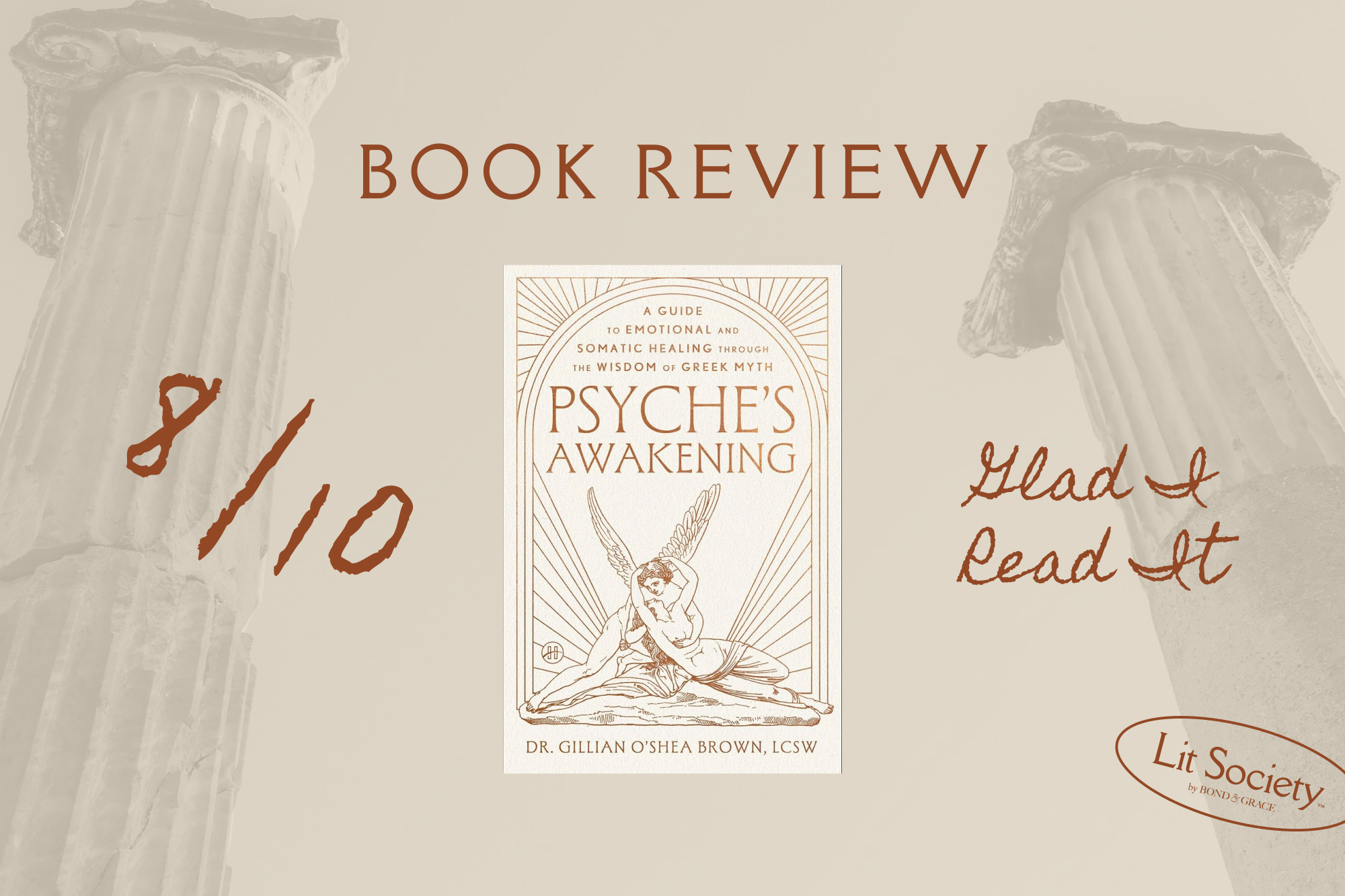
As part of Lit Society’s Book Review Program, members are reading and reviewing books by independent writers we think deserve more attention. This review reflects one reader’s honest experience and aims to spotlight exciting new voices.
Big Take? A moving and compassionate exploration of the wounds we carry and how we might transform them through the wisdom of Greek myth. Will resonate with readers drawn to mythology, psychology, and reflective approaches to healing.

- Would You Recommend It? Yes
- Book Club Worthy? Yes
- Would You Read This Author Again? Yes
- Did It Change How You See Something? Yes
- Is It More Plot or Ideas? Ideas
- Pace: Steady
- Emotional Impact: Lingering
- Best For: Deep thinking
- Skimmable or Demands Attention? Close Reading
- Would You Reread It? Yes (certain passages, yes)

Thousands of years separate us from the first tellings of the Greek myths and yet they continue to captivate and resonate with us because, in their characters’ flaws and wounds, we find fragments of ourselves. Psyche’s Awakening, at its core, illuminates those fragments, holds them with compassion, and uses them as a guide to healing.
While the characters of myth are condemned to relive the same tragedies each time their stories are told, with Dr. Gillian O'Shea Brown’s guidance, we are empowered to have the self-awareness and wherewithal to make a different choice.
Just released by HarperOne, an imprint of HarperCollins, Psyche’s Awakening blends mythology and psychology with an almost effortless charm. Tying the two together are Dr. Brown’s own experiences as a therapist and the stories of her clients: stark, honest, vulnerable accounts that make everything feel deeply familiar. Each chapter ends with an exercise that gently guides the reader through their own inner journey of healing.
This interplay between myth and personal healing begins in the first chapter, in her retelling of Echo and Narcissus. Echo, cursed to repeat only the words of others, confesses her love for Narcissus by borrowing the very same words he uses to reject her. In but a few concise lines, Dr. Brown encapsulates Echo’s tenderness and Narcissus’ cruelty, telling the famous myth with such vivid clarity that it seems to unfold before the reader rather than simply being recounted. From there, she turns toward the psychology beneath the story: Narcissus’ self-absorption robs him of the ability to connect with others, while Echo’s heartbreak is compounded by her lack of individuation. She then explores the concept of “philautia,” or self-love, and the importance of knowing and loving oneself before being able to fully give or receive love. By the end of the chapter, it is difficult not to see something of ourselves in these characters.
Psyche’s Awakening goes on to juxtapose the dark and visceral tale of Medea with the wounds carried by two of Dr. Brown’s clients: Celine, whose mother taught her that love was conditional on obedience, and Greg, whose childhood memories include a terrifying outburst from his mother over spilled milk. Through the negative images they have cultivated about themselves, we witness the deep-rooted impact of the Medean wound. (In the myth, Medea turns her children's trust into an instrument of vengeance.) Through the journeys of these clients, the scale of the myth melts away to reveal something painfully human: children needing love and safety from the very person who is also a source of danger. The chapter then turns toward “reparenting,” a therapeutic approach to healing childhood wounds, and “social pruning,” an exercise that asks the reader to pay attention to how a relationship registers in the body.
The book’s retellings are most affecting when we peer into the characters’ inner worlds. I found figures such as Phobos and the Phoenix to function more as archetypes and lack some of the intimacy that makes Dr. Brown’s stories of Echo, Narcissus, Pygmalion, Medea, and Medusa so compelling.
The figure I found myself returning to most is Chiron, the wounded healer, who embodies the possibility of turning suffering into something profound. Earlier in the book, Dr. Brown describes an inner “alchemy” as “transforming wounds into wisdom, shame into self-forgiveness, pain into purpose.” In Chiron, that idea feels most fully realized. Though he is never quite able to heal himself, his wounds become a source of compassion, wisdom, and purpose, allowing him to connect more deeply with the suffering of others. And that is how Psyche’s Awakening leaves me: with a better understanding of the wounds I carry, seen through the lens of myth, and with tools that might help transform them into wisdom, compassion, or purpose.

Favorite Line?
“The wound itself may not be your fault, but the responsibility of healing now rests with you.”
“I’ve come to see pain as the elixir the soul drinks to evolve. And though there is no ‘magic elixir’ in real life, there is something much better, an alchemy we can perform inside ourselves. The process of transforming wounds into wisdom, shame into self-forgiveness, pain into purpose, and finally reaching harmony, enlightenment, and self-realization is truly magical.”
“When we see a wilting houseplant, we do not question its value—we look at its environment. The attentive caretaker will surmise that the plant must be pruned, nourished, or repositioned to preserve its vitality. Just like pruning a houseplant promotes regrowth and vigor, establishing boundaries through social pruning may initially thin out your social circle but can lead to healthier, more fulfilling connections in the long run.”

Recommended Media?
🎵 Good Riddance — Darren Korb, Ashley Barrett
🎵 Sisyphus — Andrew Bird
🎵 Achilles Come Down — Gang of Youths
🎵 Shake It Out — Florence + the Machine
📖 The Song of Achilles — Madeline Miller
📺 Midnight Gospel
Interested in purchasing Pysche's Awakening? Support Bond & Grace and purchase the book via Bookshop here.