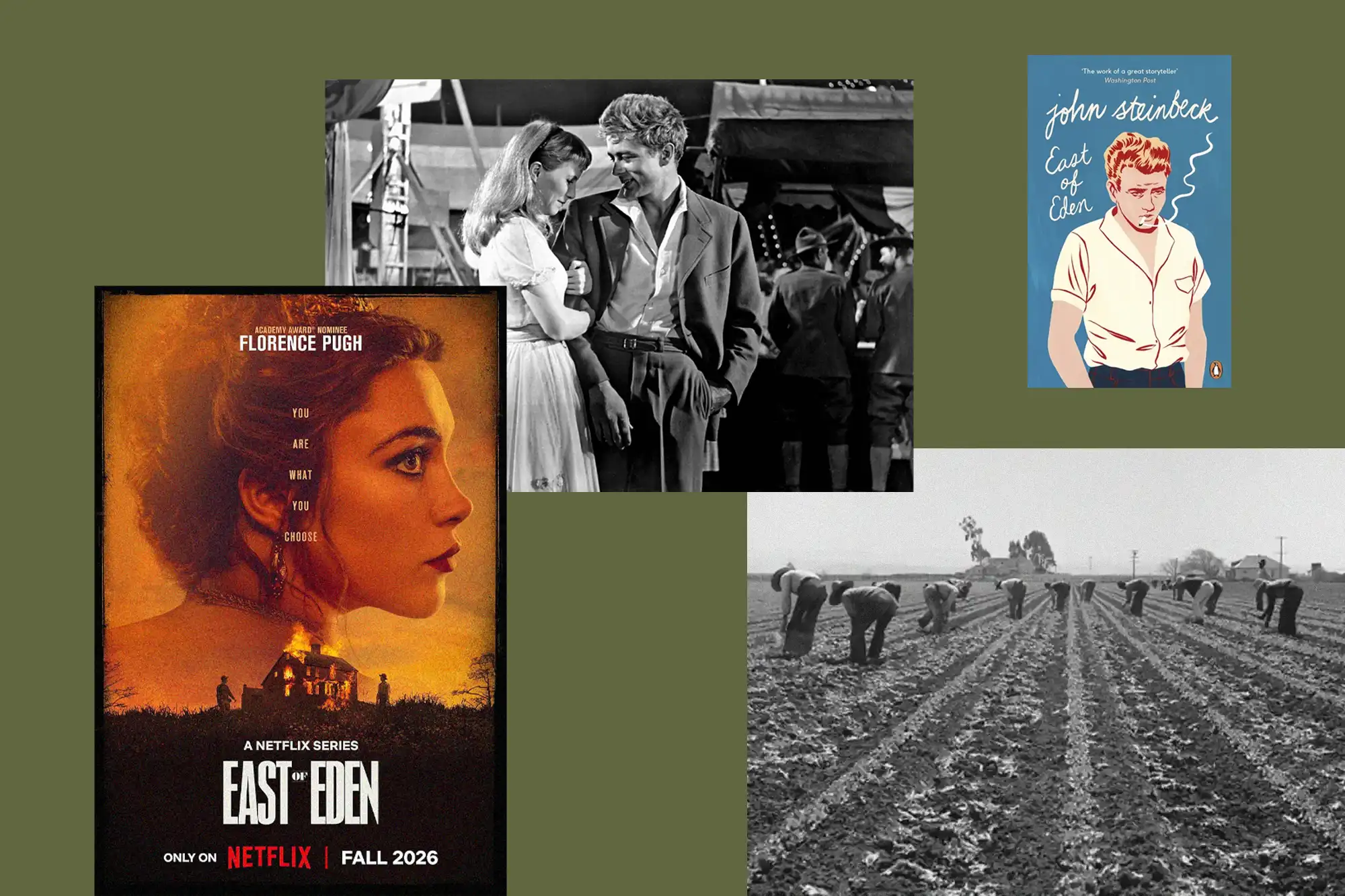
At more than 600 pages, John Steinbeck’s 1952 novel contains generations of family history, biblical interpretation, California geography, philosophical debate, sexual politics, and people making spectacularly bad decisions because they desperately want their fathers to love them. In other words, there is a lot going on.So, before watching the new Netflix adaptation, dropping on Oct 1, here are ten things worth knowing about the novel, its strange creation, its complicated moral universe, and that other famous adaptation. (You can trust me, I’ve read the novel more times than anyone I know and have timshel tattooed on my arm.)

1. Cain and Abel may be the obvious source, but Dostoevsky is lurking in the background.
It is almost impossible to talk about East of Eden without talking about the Bible and Cain and Abel.
But I would argue that another book belongs in the conversation: Dostoevsky’s The Brothers Karamazov.
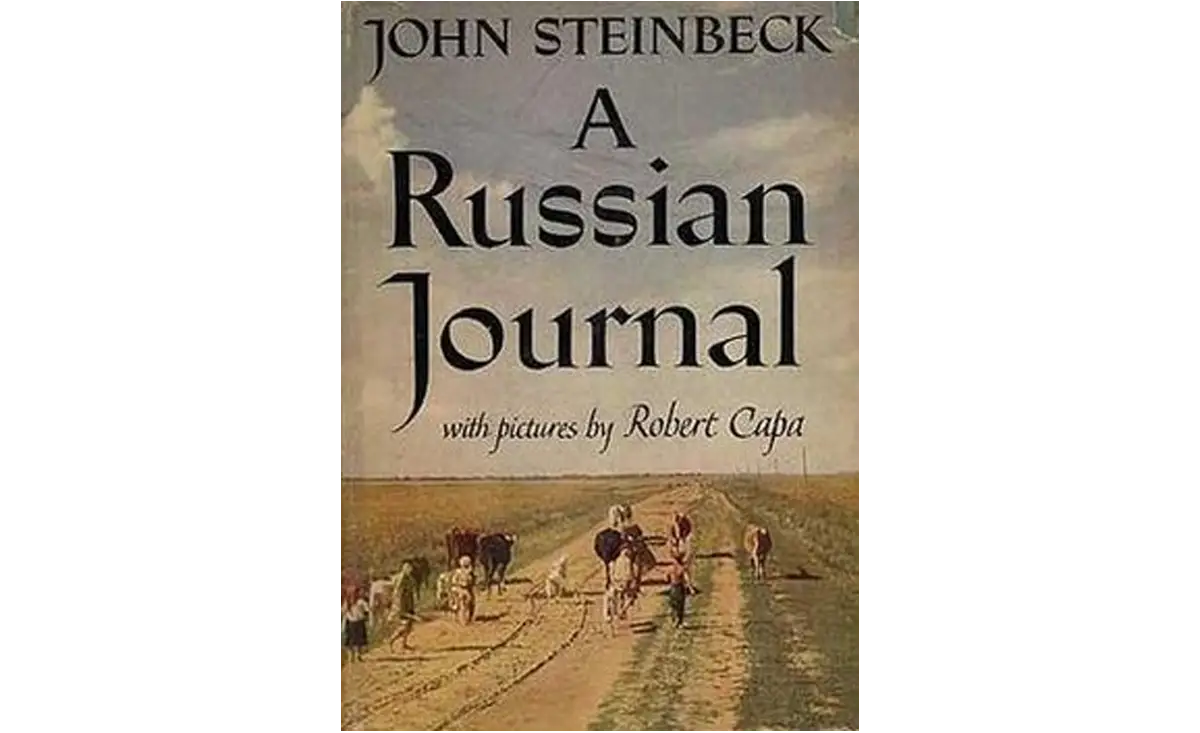
There is no neat letter from Steinbeck announcing that he sat down to rewrite Dostoevsky, but the connection is worth considering. In the years immediately before East of Eden, Steinbeck traveled through the Soviet Union with photographer Robert Capa and published A Russian Journal in 1948, the same year he began researching the novel that would become East of Eden.
More importantly, the similarities go much deeper than “there are brothers.” Both novels place spectacularly dysfunctional families at the center of enormous philosophical questions. Fathers fail their sons. Brothers become rivals while remaining bound to one another. Children wrestle with what they have inherited and whether inheritance amounts to destiny. Underneath all of it is the question of existentialism and free will: What do we owe our brothers, what do we inherit from our fathers, and are we capable of choosing who we become?
2. Steinbeck basically wrote a second book while he was writing East of Eden.
Every day from January 29 through November 1, 1951, Steinbeck sparked his creativity by writing a letter to his editor and close friend, Pascal “Pat” Covici. And he did this in perhaps the most satisfying writerly way imaginable.
Steinbeck wrote to Covici on the left-hand pages of a large notebook. Once he felt “ready to work,” he turned to the facing pages and wrote East of Eden in longhand. He described the ritual as getting his “mental arm in shape to pitch a good game.”
Those letters were eventually published as Journal of a Novel: The East of Eden Letters, and they are wonderfully revealing because Steinbeck worries about characters, structure, titles, his children, his writing, and occasionally whether any of this is working at all.
The monumental American classic on the right-hand page had a nervous author muttering to his friend on the left.
3. “Timshel” does not exactly mean what Steinbeck tells us it means.
If you have ever met someone who has read East of Eden, there is a decent chance you have also met someone who has considered getting “Timshel” tattooed somewhere on their body (cough, cough . . . like this article’s author).
In Genesis 4:7, God speaks to Cain about sin. Steinbeck became fascinated by differences between biblical translations. The King James Version gives “thou shalt rule over him,” which can sound like a promise. Another translation presents it more as a command. In East of Eden, Lee investigates the Hebrew and arrives at Steinbeck’s preferred possibility: timshel, “thou mayest.”
Mayest. You can. Or you can choose not to.
For Steinbeck, that tiny difference changes everything because it leaves the future open. Cain is neither guaranteed redemption nor condemned to repeat his crime forever. Choice remains.
There is, however, a fascinating problem: the Hebrew in Genesis is timshol, and scholars have questioned Steinbeck’s rendering of it as simply “thou mayest.” The linguistic case is considerably messier than the novel suggests. Steinbeck himself knew there was disagreement and was interested in the possibilities that disagreement opened.
4. The Hamilton family is not filler.
Because the Cain-and-Abel structure gets so much attention, East of Eden is often remembered primarily as the story of the Trasks.
That leaves out a rather important detail: there is an entire other family running through the novel.
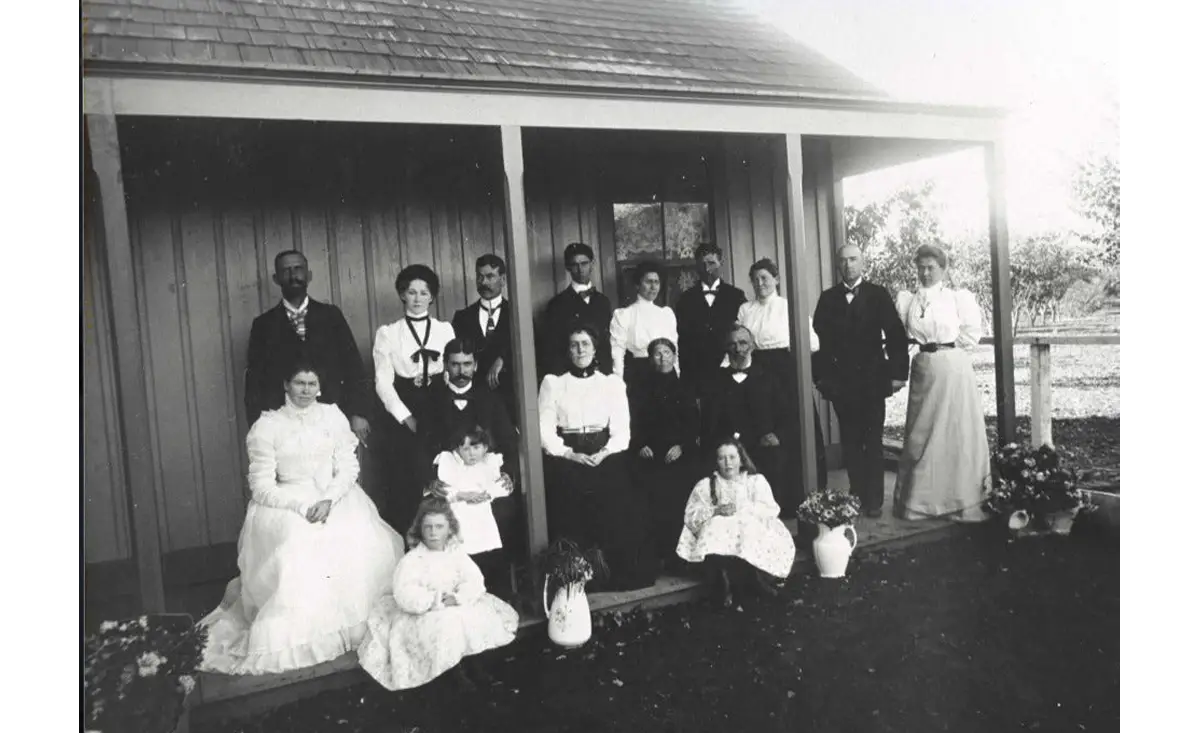
Unlike the Trasks, the Hamiltons are based substantially on Steinbeck’s own family. Samuel and Liza Hamilton were his maternal grandparents. Their daughter Olive Hamilton became Steinbeck’s mother. A young John Steinbeck even wanders briefly into his own novel.
The Hamilton material is a mixture of family history and fiction, but its presence changes what East of Eden is. The Trasks give Steinbeck his biblical mythology. The Hamiltons give him memory, ancestry, humor, geography, and home.
Samuel Hamilton in particular becomes one of the great moral and intellectual centers of the novel, a curious, inventive, perpetually cash-poor Irish immigrant who reads voraciously and somehow keeps finding his way into other people’s lives.
5. Steinbeck was writing the Salinas Valley for two particular readers.
There is a reason the landscape in East of Eden feels so alive. Steinbeck was trying to “give it” to his sons.
He imagined the novel, in part, as a way of handing Thom and John the place and family history from which they came. While working on his descriptions, he wrote about wanting to capture the sights, sounds, smells, and colors of the valley so his boys could experience them.
The Salinas Valley is not scenery somebody forgot to edit down before we finally get to the plot. Steinbeck is reconstructing home for children who did not know it as he had known it.
And he does not romanticize it completely. There is fertile land and barren land, abundance and deprivation, light and darkness. The Hamiltons themselves settle on dry, rocky acreage while the more desirable land has already been claimed. The real Hamilton ranch was so unforgiving that Steinbeck called it “Old Starvation Ranch.”
6. Cathy Ames is more complicated than an “evil woman,” even when Steinbeck himself calls her a “monster.”
Cathy Ames is one of Steinbeck’s most infamous creations, and the narrator does not introduce her neutrally. He explicitly asks us to consider the possibility that monsters can be born.
So yes, Steinbeck is doing a lot to push us toward “Cathy = evil.”
But more recent scholarship has questioned whether we should simply accept the narrator’s diagnosis of Cathy, particularly because she refuses nearly every role available to a respectable midcentury woman: wife, mother, nurturer, obedient sexual partner. Some scholars read her monstrosity through precisely those anxieties about gender and domesticity.
And then there is prostitution.
It is easy to read Cathy’s eventual association with a brothel as one more piece of evidence in a straightforward moral equation: Cathy is bad, therefore Cathy enters a “bad” profession.
Except Steinbeck does not consistently treat prostitution that way.
In Cannery Row, Dora Flood runs the Bear Flag Restaurant, a brothel, and she and the women who work there are among the community’s most generous inhabitants. During an influenza outbreak, Dora sends the women out to nurse sick families and care for children. Steinbeck repeatedly separates conventional respectability from actual goodness, meaning he is much more interested in what people do than whether society has classified them as respectable. That distinction is worth remembering when Florence Pugh walks onscreen.
7. Steinbeck did not particularly like James Dean.
Before Florence Pugh, there was James Dean.
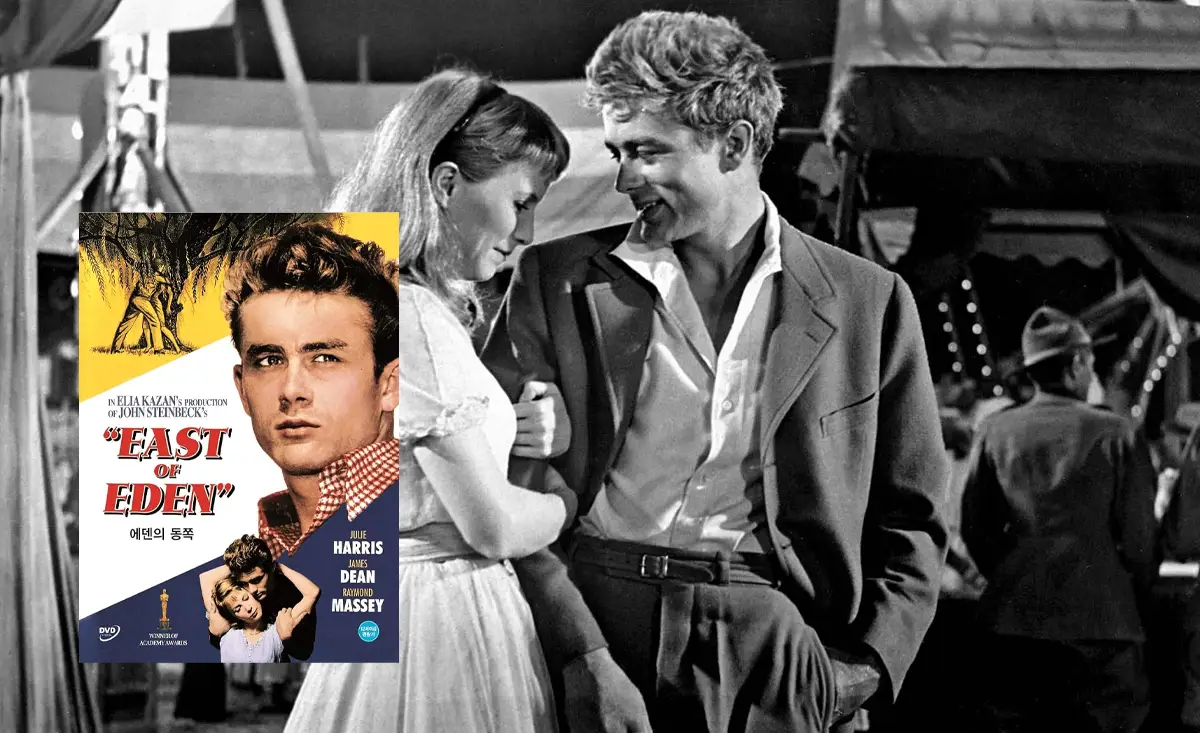
The 1955 film East of Eden, directed by Elia Kazan, gave Dean his first major starring film role as Cal Trask and helped create the cultural image that would follow him after his death later that same year. The casting process, however, was not exactly love at first sight.
Steinbeck did not like Dean when they met. Yet that personal reaction became almost irrelevant once he saw what Dean could do with Cal. Whatever he thought of Dean himself, he recognized the character.
Cal spends much of the novel terrified that something inside him makes him inherently bad, while desperately wanting to be loved anyway. Dean brought an uncomfortable, restless physicality to him that fit the character remarkably well.
8. The James Dean movie barely adapts the book most people think it adapts.
This one surprises people who know the movie better than the novel.
Elia Kazan’s 1955 East of Eden does not attempt to tell Steinbeck’s enormous multigenerational story. It concentrates primarily on the final portion of the novel, centering Cal, Aron, Adam, Abra, and the discovery of what became of Cathy.
Think about what that means. Charles and Adam’s childhood? Mostly gone. Cathy’s early history? Gone. Samuel Hamilton and most of the Hamilton family saga? Gone. The long development of the Cain-and-Abel pattern across generations? Drastically reduced. Lee’s full philosophical importance? Reduced.
The 1955 film is excellent at what it chooses to be, but it is essentially one section of an enormous family epic that has become culturally synonymous with the whole thing.
So, if your mental image of East of Eden begins and ends with James Dean brooding beautifully in a sweater, there is an alarming amount of East of Eden you have never met.
9. The A and C names are obvious because Steinbeck wants them to be.
Charles and Adam. Caleb and Aron. Cain and Abel. Cathy. Once you notice the naming pattern, it can feel almost comically obvious. But that is also the point.
Steinbeck is not trying to hide the Cain-and-Abel allegory and reward particularly clever readers for discovering it. He practically smacks us in the face with it. He does this elsewhere in his work too, using obvious symbols, biblical parallels, archetypes, and allegorical structures as a way into much less obvious questions.
In East of Eden, the prescriptive quality of the names matters because the novel is ultimately interested in whether we can break away from a prescribed life at all. We know the story. We know how it ends. And because Steinbeck has made the pattern so obvious, we begin expecting his characters to follow it.
That expectation becomes the authorial trap for us readers.
Steinbeck gives us an almost aggressively obvious allegory so that he can eventually ask us to abandon it. Recognizing the allegory is not the intellectual endpoint. It is where the reading begins. The interesting part is realizing that Cal can recognize the story he has inherited and still choose what happens next.
10. East of Eden is the book Steinbeck wanted to put everything into.
By the time East of Eden appeared in 1952, Steinbeck had already written Of Mice and Men, The Grapes of Wrath, The Pearl, Cannery Row, and many of the works that had made him one of the most recognizable American writers of his generation.
Yet East of Eden was unusually personal. You can feel him trying to shove everything into it: his family, California, childhood memory, fathers and sons, brothers, sex, violence, goodness, cruelty, religion, language, immigration, class, agriculture, war, modernity, and the question of whether people can ever escape what has been handed down to them.
Even the title took time. During composition Steinbeck considered other names before eventually turning to Genesis 4:16, where Cain leaves the presence of God and settles “east of Eden.” That title tells us where Steinbeck is really interested in placing his characters.
They are not in Eden.

The mistake has already happened. The family is already damaged. The brother has already hurt the brother. Parents have already failed children, and children have already disappointed parents. Everyone is living somewhere east of paradise. The question is what you do once you get there.
And that is probably the most useful thing to know before watching any adaptation of East of Eden. For all the talk of Cain and Abel, good and evil, A names and C names, Steinbeck ultimately becomes much less interested in determining which category a person belongs to than in asking what that person does next.