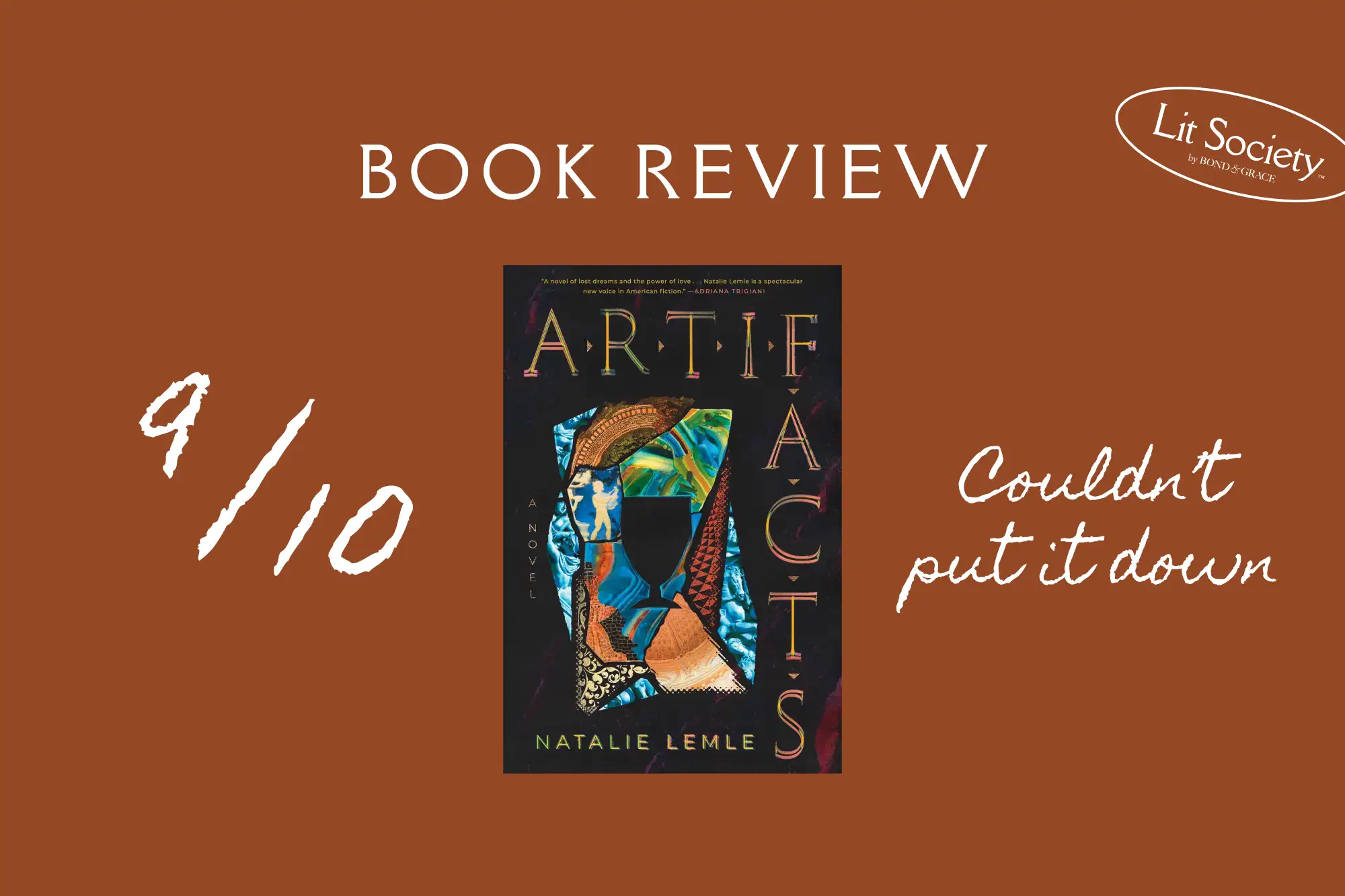
As part of Lit Society’s Book Review Program, members are reading and reviewing books by independent writers we think deserve more attention. This review reflects one reader’s honest experience and aims to spotlight exciting new voices.
Big Take? A sophisticated literary art mystery with dual timelines set between New York City and Italy in which worlds collide and loyalties pull in opposing directions, Artifacts is perfect for readers who love museums as much as they love adventure, and will appeal to anyone who has ever stood, awe-struck, in front of an artwork and wondered at its journey through space and time.
- Would You Recommend It? Yes
- Book Club Worthy? Yes
- Would You Read This Author Again? Yes
- Did It Change How You See Something? Yes
- Is It More Plot or Ideas? Plot
- Pace: Steady
- Emotional Impact: Lingering
- Best For: Quiet, rainy weekend spent inside
- Skimmable or Demands Attention? Close Reading
- Would You Reread It? Yes (I’ve already read it twice!)
Lena Connolly’s secrets are so dangerous that she kept them from herself for nearly two decades… We meet Lena, a successful attorney living in New York City, in 2022, as she is assigned to the defense team of a curator of a university museum in a looted antiquities lawsuit. Her investigation of the claim and of the object itself—a stunningly rare cup made of dichroic glass—forces her to confront a series of unsettling experiences she had back in 2004 as a student on an archaeological dig in Italy.
It won’t be a comfortable trip down memory lane for Lena, who has worked hard to bury the past. The process of (re)discovery will be frightening, potentially even violent, but the time for reckoning has arrived: “A sudden calmness comes over me. Some part of myself, I understand, is being unearthed. An old drive, an old yearning…” (page 6). This yearning, we see, is not just for the beautiful, sun-drenched Italian countryside, or even for the long, rewarding days spent working in dirt-filled trenches of the excavation site that first provided her a direct, unmediated encounter with antiquity. Rather, her yearning is best characterized as a desire to challenge the willful ignorance of her younger self and to finally acknowledge her complicity in the whole sinister affair so that she can find closure.
Lena quickly understands that she knows more about the cup than she perhaps should, given her proximity to the case. What begins as a legitimate legal investigation becomes both a liability and an excuse as Lena reconnects with an old lover and their mutual contacts. As she claws her way through a web of memories and suspicions, she realizes that in the deepest circles of crime, politics, and power—and especially the currencies of black market art and cultural heritage that sustain them—coincidences are as rare as the dichroic glass cup that led her there.
Author Natalie Lemle is clearly at home writing about academia, museums, archaeology, and the art world. She captures these distinct yet overlapping spheres in an authentic way—the details of her settings, characters, and their idiosyncratic speech and mannerisms ring true to me as someone who has made a career in these same fields. She achieves convincing realism and provides her reader a steady ground from which to enjoy an extraordinary, thorny, and suspenseful story.
Lemle’s expertise and enthusiasm for classics and art history shine through the pages—indeed, she is credentialed in both—and she gives us a brilliant and convincing portrait of her protagonist Lena, in whom we see a woman coming into her own, both romantically and professionally, in the context of her passions. Lemle further excels at chronicling her characters’ development in subtle, memorable ways. See here, where Lena reaches a turning point in her Italian summer, losing herself by slipping thoughtlessly into the routines and habits of those around her: “Every time someone had offered me a cigarette that summer, I’d waved them away. But this time I put it between my lips and breathed in.” (pages 192-3) In this small moment, she has become someone else, her loyalties have shifted, and her path can only lead in one direction.
Through her characters, Lelme offers a nuanced critique of the antiquities trade. As Lena observes, “When I went to museums, I always had the sense that the antiquities were out of place—estranged even. They were vulnerable, the way they were forced to bear themselves unnaturally in sterile glass cases, completely removed from their intended origins and uses.” (page 33) Heavy-hitting themes like repatriation, nationalism, and corruption lurk in the background, but particular views are not forced on the reader; there is no “right take.” This is a book that can be enjoyed by a wide and general audience. Still, it rewards close reading and stands up to an expert’s analysis, and devotees of the ancient Mediterranean will appreciate the nods to historical people and places. There are also lovely surprises and flashes of recognition in store for those who speak French and Italian.
Artifacts is a supremely intelligent novel that captures both the glamor of the art world and its dark underbelly. Did it happen? I hope not. Could it? Maybe! Pick it up; you’re in for a treat.
Favorite Lines?
“I liked who I seemed to be in Cyrille’s eyes: a worthy vessel into which information could be poured. He was doing most of the talking, but I felt unearthed, held, sensing his voice as a vibration rather than hearing it—understanding, maybe for the first time, that human existence was more than a linear march toward some arbitrary goal, that time could be bent, that the past could be readily accessed and recast.” (page 18)
“When I put the statue back on the pedestal, her eyes were saying something—it seemed as though she were pleading with me to pick her back up. She had mistaken me for someone who understood she didn’t belong here.” (page 108)
“The external will decay. Ancient sculptures break, papyri disintegrate, humans age; but the internal, the intangible, can persist. The soul of a thing can stay the same. This is why ancient objects have value. This is why people care about them, and why countries fight over them. Because the soul of them persists. We sense this, as humans, even if we can’t see it with our eyes.” (page 303-4)
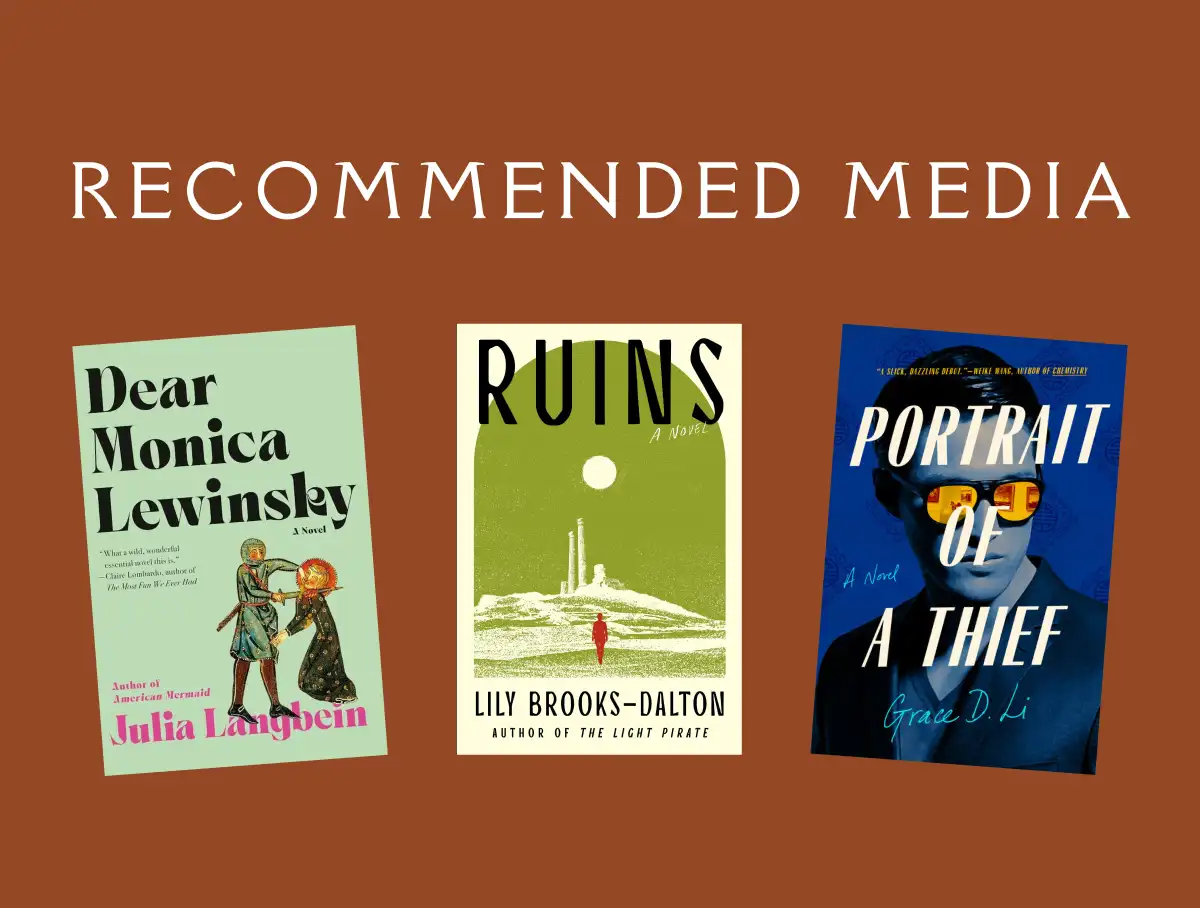
Recommended Media?
I read these novels, similar in theme or vibes, in the past year and can highly recommend all three!
📖 Dear Monica Lewinsky by Julia Langbein
📖 Ruins by Lily Brooks-Dalton
📖 Portrait of a Thief by Grace D. Li
Interested in reviewing books for Lit Society? Join our growing team of member reviewers and help champion independent authors and unforgettable reads.